

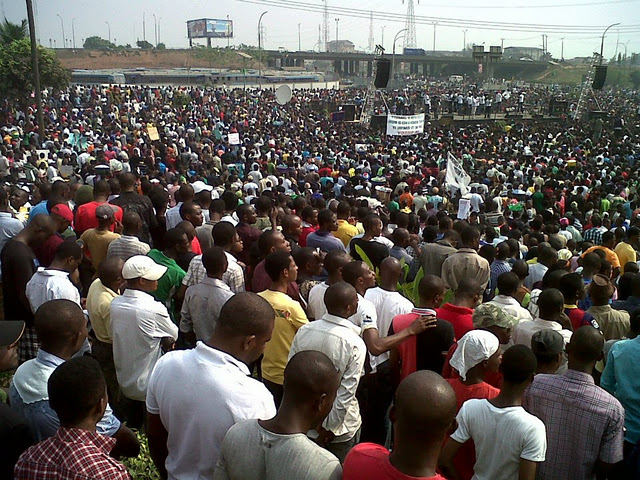
occupy Nigeria Gani Fawehimi Freedom park Ojota Lagos
Our first task shld b to “aggregate
D discontent of d suffering
masses of Nigeria: The ones who
die when a bomb explodes in a
market square; those who subsist
on less than one dollar a day; those
who die from preventable diseases.
We all must learn to overcome our
differences and confront our
common enemies. Hunger, poverty,
and diseases transcend ethnic
origins or religious affiliations”.
The second part of What is to be
done reads: “Nigerians shld
prepare themselves mentally and
psychologically to occupy every
public space, from the local
government to the national level,
as well as our embassies in
Washington, Ottawa, Paris, London,
and other major cities around the
world when the time comes”. The
third part is ideological:”
Governments are supposed to serve
the people. But when they renege
on that task, the people have a
responsibility to assert their
citizenship rights. We have seen it
happen before our very eyes in
North Africa and the Middle East”.
I endorse these broad statements,
but would like to conclude with the
following comments. In the rules for
critics (which were suggested last
Thursday), I opted not to quarrel
over words and names if I have no
quarrel with their contextual
meanings. It is for this reason that I
refrain from quarrelling with the
concept of reclaiming Nigeria. To
reclaim, as I understand it, is to take
back. I am aware that this
ideological slogan, together with
Occupy Nigeria, is now popular with
radical patriots, democrats and
human rights activists in Nigeria.
But I doubt if the Nigerian masses
had, at any time since Nigeria was
created in 1914 and especially since
independence in 1960, owned
Nigeria.
Having said this, I associate myself
with the twin slogans for the
reasons stated above and because I
support their physical political
expressions – protests, marches and
occupations. Their power– as well
as their limitations–have been
strongly demonstrated in the “Arab
Spring” and during the nation wide protest that followed the removal of oil subsidy on January 1st 2012. These protest has resulted into a probe of the subsidy issue, and the revelations from the House of representatives committee headed by Hon. Faruk lawal has exposed startling high level corruption in the down stream petroleum sector. Subsidy was paid for Products which hv not been imported,over payments e.t.c The probe has also exposed lack of coordination among various Government agencies who gave conflicting figures about consumption and payments, infact none of the agencies has an accurate figure in all their submissions.
What happened in
the Arab-majority countries
concerned – Egypt in particular –
can either be taken as
demonstration of the theory of
permanent revolution or the power –
and – limitation of “reclamation”
and “occupation”, or both. However,
I shall continue to understand
reclaim as liberate.
Many of my comrades and
compatriots, including the author of
Time to reclaim Nigeria, were quite
enthused by the essentially anti-
capitalist mass movement which
swept America in the second half of
2011. These comrades and
compatriots had earlier reacted
enthusiastically to the Arab Spring,
but the “democratic” and non-
violent character of Occupy
Movement makes the American
model more “appealing”. It is
however, imperative to find out to
what extent each “model” was
deliberately chosen by the people
concerned and to what extent it was
dictated by circumstances. It is also
imperative to enquire if the model
that played out in each case was a
consensus or the case of the
temporarily dominant tendency
imposing itself.
Extracts from the book review ‘Time to reclaim Nigeria’ by Edwin Madunagu

Discover more from IkonAllah's chronicles
Subscribe to get the latest posts sent to your email.
