

As General Muhammadu Buhari (rtd) sat in
front of the TV watching his election
victory unfold, the future president took
care to be photographed beside a Muslim
Cleric and a bishop,a
statement of unity in a religiously mixed
nation.
More importantly for investors, over the
left shoulder of the purple-robed bishop
was a smiling figure in a sharp grey suit:
Aliko Dangote, the most celebrated
business magnate and Africa’s richest
man.
An ascetic former military ruler, Buhari
built his stunning electoral landslide on
promises to clean up the country’s
notoriously filthy politics and get tough
on the Boko Haram insurgency raging in
the northeast.
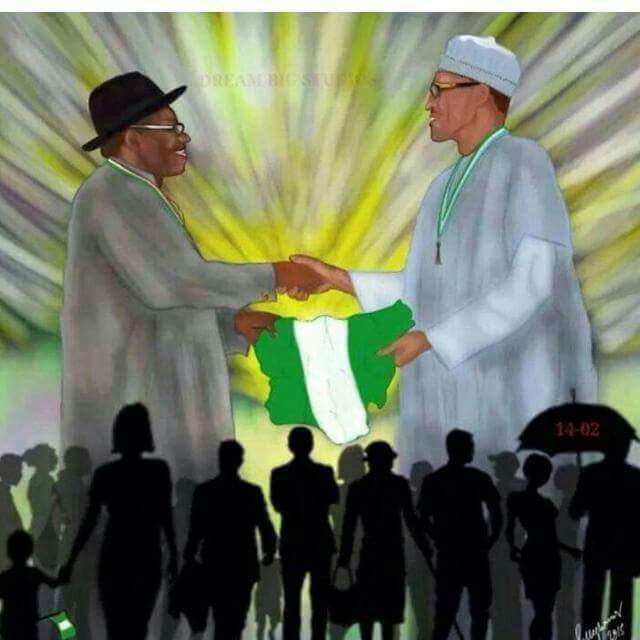
He returned to those themes in his first
official speech as president elect,
stressing a zero tolerance approach to
corruption and saying he would “spare
no effort” to defeat the Islamist
militants who have killed thousands in
the northeast.
It is less clear what his victory means for
Africa’s biggest economy, under pressure
from the collapse in the oil price, but
Dangote’s grinning, capitalist presence
in the sandal-wearing general’s inner
circle at his moment of triumph looks
reassuring.
In the most glaring endorsement of
Buhari – as well as relief that the
elections avoided the violence of
previous polls – the stock market leapt
more than 8 percent in the immediate
aftermath of his win.
Bonds also climbed, while the naira,
which has lost 20 percent of its
purchasing power in two devaluations
since November, gained 0.5 percent on
the black market to 217 to the dollar. It
remained fixed at 197 in official
interbank trade.
‘New Buharism?’
This is not to say all is set fair for the
72-year-old, whose last time in office
was 20 months as a military dictator in
the mid-1980s.
Then, his response to a yawning trade
gap and runaway inflation was to fix
prices and ban “unnecessary” imports,
rather than let the currency depreciate,
under an economic programme
dubbed ‘Buharism’.
For good measure, he also cut ties with
the International Monetary Fund and
ordered his soldiers to instill descipline on people who
failed to form orderly queues at public spaces like bus
station.
Buhari’s political views have mellowed
since then, and his relationship with
Dangote, whose business empire stretches
from cement to pasta, suggests his
economic ones have gone the same way.
But he faces many dark clouds on the
horizon.
From President Goodluck Jonathan, who
stunned Nigeria’s 170 million people with
a gracious concession speech, Buhari
inherits an economy decelerating
sharply from the 7 percent annual
growth to which it has become
accustomed.
Standard and Poor’s cut Nigeria’s credit
rating two weeks before the vote and
Fitch lowered its outlook on the eve of
the polls – both moves that will increase
Abuja’s borrowing costs.
Meanwhile, the oil price languishes at
around $55 a barrel, half its level of a
year ago and a massive blow to a
country that relies on crude sales for 80
percent of government revenues and 95
percent of foreign exchange.
Outside the capital, huge road-building
projects lie deserted and half-finished
and cranes stand idle across its skyline,
testament to a construction sector pole-
axed by the government’s difficulty in
paying its bills.
Foreign reserves have dropped by a
third in the last year to below $30
billion.
Against such a backdrop, Buhari – now
free of the need to get elected – will
have few options but to cut Nigeria’s
cloth to a more appropriate size,
analysts say.
“Nigeria has been postponing a really
important macro-economic adjustment
because of the sensitivity of voters,”
said Jan Dehn, head of research at
Ashmore Group, an emerging markets
investment manager. “That’s really
critical for investors.”
‘Least awful’
In practical terms, that means cutting
government spending, hammering the
corruption that overshadows every facet
of life, and letting the naira find a
more stable – and lower – footing to
stem the bleeding of central bank dollar
reserves.
“The currency still needs to adjust to
take into consideration lower oil prices,”
said Claudia Calich, an emerging bond
fund manager at M&G Investments in
London. “The earlier they do this, the
better.”
Others said Buhari could be forced to
take the unpopular move of hiking taxes
to plug the gap left by oil receipts.
“We expect a reformist administration
that will impose austere policies,” said
Yvonne Mhango, an economist at
Renaissance Capital in Johannesburg.
“Limited fiscal resources imply upside
risk to taxes.”
Meanwhile, Nigerians who for the
first time realised the power of an
unfettered ballot box will be breathing
down his neck demanding results –
especially since voting was in many cases
anti-Jonathan rather than explicitly
pro-Buhari.
In a scathing Economist editorial that
will not have been lost on many
Nigerians, the magazine grudgingly
endorsed Buhari as merely the ‘least
awful’ of the two choices put before
them.
“It’s not so much that people love
Buhari. But they were tired of this
stagnation, this lack of movement, this
seeming cluelessness of administration,”
said political analyst Ebun-Olu
Adegboruwa.
“It’s not so much ‘Hosannah,
Hosannah’. People will be crying ‘Crucify
him’ if he’s unable to perform.
views expressed are not necessarily the opinion of blog author.
Discover more from IkonAllah's chronicles
Subscribe to get the latest posts sent to your email.
