
By Abdul Kezo
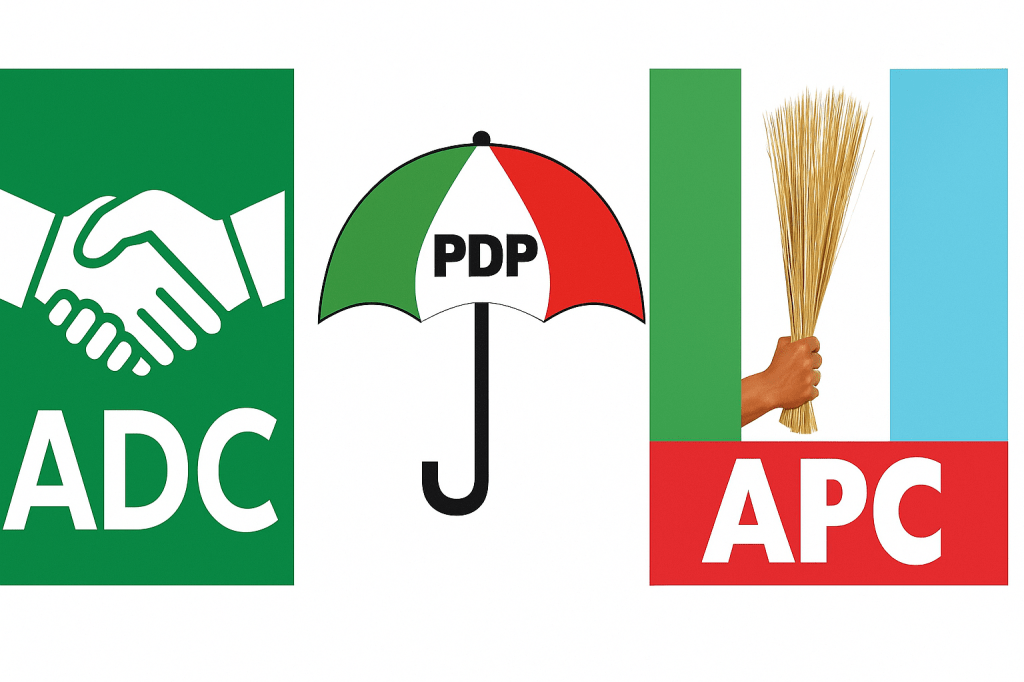
Nigeria’s political atmosphere is once again heating up—early and intensely—following the announcement of a new coalition of political actors adopting the African Democratic Congress (ADC) as a platform for the 2027 general elections. While this development has generated fresh debates about the viability of opposition politics, it also reflects deeper undercurrents shaping the broader political terrain. The coalition is only a symptom of a more complex political reality—one marked by discontent, weak institutions, and rising uncertainty.
A Fractured Landscape
The ruling All Progressives Congress (APC) remains the dominant political force, holding the reins of power at the center and in most states. However, it is not without internal tensions. Economic challenges, growing insecurity, and widespread poverty continue to test the administration’s capacity and popularity. Many Nigerians feel disconnected from governance, with trust in political leadership at one of its lowest points since the return to democracy in 1999.
The main opposition party, the People’s Democratic Party (PDP), once a formidable structure, has struggled to recover from internal divisions, defections, and poor electoral performance. What remains is a fragmented opposition space—fertile ground for new alliances but also for chaos.
It is within this context that the newly announced coalition seeks relevance, positioning itself as a “third force.” But whether this coalition represents a genuine alternative or merely a regrouping of disenchanted political actors is the subject of widespread debate.
Hope or Recycling?
Opinions on the coalition are sharply divided. Optimists see it as a potential lifeline for Nigeria’s democracy—an opportunity to inject fresh energy into a stale political order. They believe that a coalition, if well organized, could unify disillusioned voters and create momentum for change, much like the APC did in 2015.
On the other hand, critics argue it is merely a gathering of politicians who have lost out in their traditional strongholds. The coalition, in their view, lacks ideological clarity, national reach, and the kind of grassroots mobilization needed to challenge the status quo. For many, it’s political recycling—old wine in new wineskins.
Personally, I see little innovation in the political ideas being floated by the coalition. However, their emergence highlights a key democratic necessity: a vibrant and competitive opposition. Even a flawed opposition is better than none. But opposition alone is not enough.
The Bigger Issue: Nigeria’s Electoral Machinery
At the heart of Nigeria’s political challenges is not just the weakness of opposition, but the credibility of the electoral process itself. The last election cycle was marred by inconsistencies, logistical failures, and allegations of manipulation. Without fundamental reforms, even the most promising political movement will be neutralized before it gains traction.
The recommendations of the Justice Uwais Electoral Reform Panel, which advocate for the independence of INEC, prosecution of electoral offenders, and reduced executive interference, remain the most credible path toward restoring public confidence in the ballot. Yet, successive governments have ignored these recommendations. If we approach 2027 with the same flawed structures in place, the outcome might not only be disputed—it may further erode democracy itself.
Institutional Power vs. Opposition Realities
Even assuming the coalition gains some ground, it will face monumental challenges. Financing is a major hurdle. In a system where the ruling party can leverage state instruments to suppress opposition funding, mounting a national campaign becomes an uphill battle. Many opposition parties have struggled under the weight of regulatory pressure, bank account freezes, and targeted investigations. Without financial freedom and legal protection, even the most promising coalition may collapse under pressure.
Additionally, regional and ethnic divisions still define much of Nigeria’s political engagement. Any coalition without broad-based appeal across the North, South, East, and West will find it hard to build the critical mass needed for electoral success.
But Never Say Never
History, however, warns against writing off political outsiders. In 2015, many dismissed the then-new APC as a shaky merger of strange bedfellows. But with discipline, shared purpose, and effective messaging, they unseated an incumbent president for the first time in Nigeria’s history.
Globally, unexpected political outcomes—from Donald Trump’s shock win in the U.S. to Emmanuel Macron’s meteoric rise in France—remind us that in politics, nothing is ever fully predictable. A scandal, economic downturn, or widespread social agitation could radically alter the political equation before 2027.
What Lies Ahead?
Nigeria stands at a critical juncture. The economy is fragile, insecurity remains unresolved, and the population—especially the youth—is increasingly restless. The political class must recognize that legitimacy now comes not just from winning elections, but from doing so transparently and credibly.
The coalition may or may not succeed, but their presence signals a desire for something different. Whether they become a powerful political force or fade into irrelevance depends not just on their internal organization, but on the space the system allows them to operate in.
More importantly, the road to 2027 must not be about personalities alone. It should be about fixing the rules of engagement—ensuring free and fair elections, protecting democratic institutions, and allowing space for dissent and competition. Without these, Nigeria risks entering another cycle of contested power, rising public discontent, and weakened governance.
Conclusion
As the dust settles around the coalition announcement, Nigerians must ask deeper questions: What kind of political system do we want? Are we content with periodic elections without true choice? Can we afford another electoral cycle marred by manipulation, apathy, and violence?
2027 is still two years away, but the decisions made today will determine whether it marks a turning point or another lost opportunity. What Nigeria needs is not just a new political party—it needs a new political culture.
Only then can we begin to rebuild trust in our democracy.
Discover more from IkonAllah's chronicles
Subscribe to get the latest posts sent to your email.
