
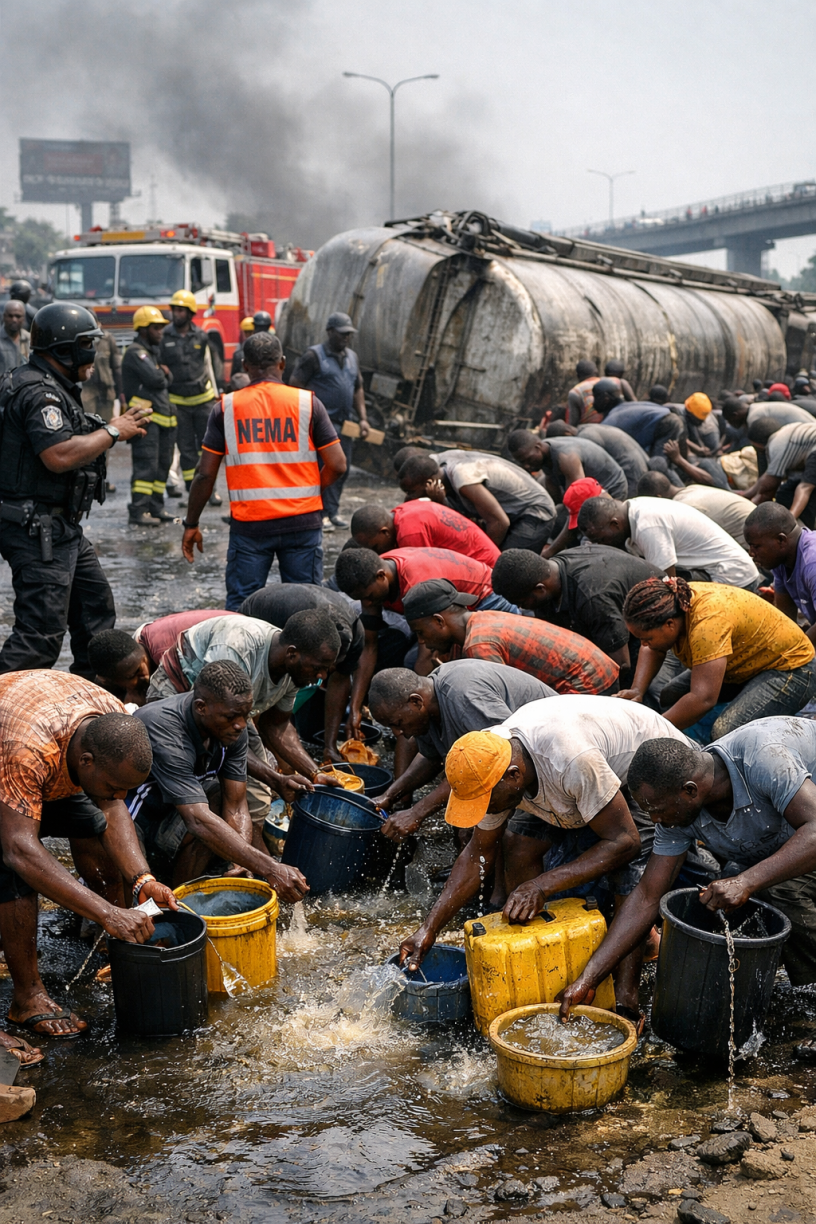
Yesterday’s disturbing scenes from Lagos—Nigeria’s supposed commercial capital—where residents were seen scooping fuel from a fallen tanker despite repeated warnings, underline a painful national paradox. In a city that hosts financial institutions, multinational corporations and the nation’s busiest ports, citizens still risk instant death for a few litres of petrol. This is not ignorance alone. It is a convergence of poverty, desperation, weak enforcement and a culture of fatalism that has outlived decades of tragic lessons.
Fuel scooping is not a new menace. From Jesse to Otedola Bridge, from the outskirts of cities to busy expressways, Nigeria has buried thousands of its citizens in firestorms triggered by this deadly practice. Each incident follows a familiar script: a tanker crashes, crowds gather, warnings are ignored, an explosion occurs, condolences are issued—and then we move on, until the next inferno.
The Root Causes: Beyond Ignorance
It is tempting to attribute fuel scooping solely to lack of awareness, but that would be a convenient lie. The real drivers are deeper and more uncomfortable.
First is economic desperation. For many Nigerians, especially informal workers and the urban poor, scooping fuel is seen as opportunity, not recklessness. With rising fuel prices, unemployment and shrinking purchasing power, petrol has become both commodity and currency. A few jerrycans can mean transport fare for weeks or quick cash in the black market. Hunger, as the saying goes, does not listen to lectures on safety.
Second is normalisation of risk. Years of hardship have conditioned many citizens to live on the edge. When daily life itself feels like survival, abstract warnings about “possible explosions” lose urgency. People assume disaster is for others—until it isn’t.
Third is weak deterrence and crowd psychology. In many incidents, the absence or delay of law enforcement emboldens crowds. Once a few people begin scooping fuel without immediate consequences, others follow. The crowd provides both anonymity and false reassurance.
Finally, there is poor road and haulage safety. Many tanker accidents are preventable—caused by bad roads, poorly maintained vehicles, driver fatigue or reckless driving. When prevention fails, emergency response must be swift; often, it is not.
NEMA and NOA: Doing the Talking, Fighting the Tide
To be fair, the National Emergency Management Agency (NEMA) and the National Orientation Agency (NOA) have not been silent. Over the years, both agencies have invested significantly in public sensitisation—through radio jingles, television programmes, community outreaches, school campaigns and social media messaging. NEMA, in particular, routinely issues safety advisories warning citizens to stay away from fallen tankers and report incidents immediately. NOA has framed the issue as a civic responsibility, appealing to collective sense and national values.
However, sensitisation alone struggles when it collides with empty stomachs and weak enforcement. Awareness does not automatically translate to compliance. Many of those scooping fuel already know the danger; they simply calculate—wrongly—that the risk is worth it.
What Must Change: From Warnings to Systems
If Nigeria is serious about ending this recurring tragedy, a more layered response is required.
First, rapid-response security and emergency cordons must become non-negotiable. The moment a tanker falls, police, civil defence and emergency responders should immediately secure the area and enforce exclusion zones. Crowds should not have time to gather.
Second, there must be real consequences. While compassion is necessary, deliberate fuel scooping from accident scenes should attract penalties—not as punishment for poverty, but as deterrence to mass death.
Third, Nigeria must invest in prevention: stricter regulation of tanker operations, mandatory rest periods for drivers, better vehicle inspections, and safer road infrastructure. Every avoided crash is dozens of lives saved.
Fourth, sensitisation must evolve. Messages should be community-specific and brutally honest—showing real consequences, survivor testimonies and the long-term impact on families. Traditional leaders, transport unions, market associations and religious institutions should be fully integrated into this messaging, not treated as afterthoughts.
Finally, the bigger elephant must be addressed: economic vulnerability. As long as millions live one accident away from opportunity, dangerous behaviour will persist. Social protection, job creation and affordable transport alternatives are not just economic policies—they are disaster-prevention tools.
A Choice We Keep Making
Fuel scooping is not merely a safety issue; it is a mirror reflecting Nigeria’s social and economic fractures. That it still happens in Lagos makes it even more damning. Until we stop treating each incident as isolated madness and start confronting the systems that make such choices seem rational, warnings will continue to be ignored, sirens will continue to wail, and mass burials will continue to follow.
The fire does not discriminate. Poverty may explain the choice, but it does not survive the explosion.
Discover more from IkonAllah's chronicles
Subscribe to get the latest posts sent to your email.
