
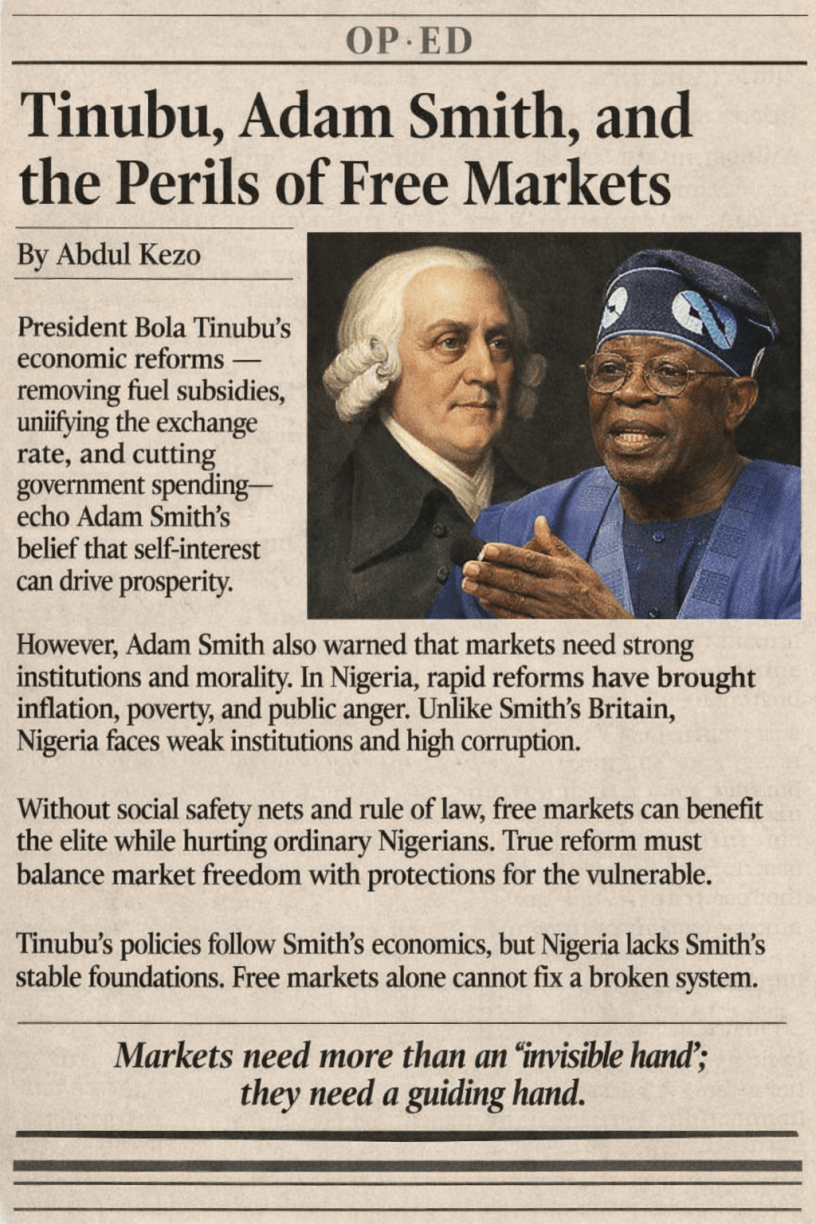
By Abdul Kezo IkonAllah
When President Bola Ahmed Tinubu announced the removal of fuel subsidies and the unification of Nigeria’s foreign exchange market, many economists applauded the boldness of the reforms. To others, it felt like an economic earthquake.
Yet, beneath the politics and pain lies a deeper philosophical question: is Nigeria finally embracing Adam Smith’s free-market capitalism?
Adam Smith, the 18th-century Scottish economist and author of The Wealth of Nations, argued that individuals pursuing their own economic interests could inadvertently promote the welfare of society. This mechanism, famously described as the “invisible hand,” suggested that markets, when left relatively free, allocate resources efficiently, encourage innovation, and generate prosperity.
Tinubu’s economic agenda mirrors this classical liberal philosophy. By removing subsidies, liberalising the exchange rate, discouraging deficit financing, and courting private investment, the administration has signalled a decisive shift away from state-controlled pricing and towards market-determined economics. In essence, Tinubu is betting that Nigeria’s prosperity will be driven by private enterprise, competitive markets, and investor confidence rather than government largesse.
In theory, this is Adam Smith’s capitalism in action.
However, Adam Smith was never a simplistic champion of unregulated markets. In The Theory of Moral Sentiments, he emphasised morality, sympathy, and social responsibility. He believed that markets function best within strong institutions, rule of law, and ethical norms. Without these, self-interest could degenerate into exploitation, inequality, and social instability.
Nigeria’s predicament lies in this missing institutional foundation.
Tinubu’s reforms were implemented rapidly—what economists call “shock therapy.” While such policies may be orthodox and economically rational, their social consequences have been severe. Inflation surged, transport costs multiplied, and millions of Nigerians slipped deeper into poverty. For many citizens, the invisible hand of the market feels more like an invisible hammer.
Smith’s Britain had relatively functional institutions, low corruption, and social trust. Nigeria, by contrast, battles weak governance structures, elite capture of economic opportunities, and pervasive mistrust in public institutions. In such an environment, liberalisation can empower monopolies, politically connected businessmen, and rent-seekers rather than genuine entrepreneurs. Markets may be free in theory, but they are not necessarily fair in practice.
Yet, this critique should not be mistaken for a defence of subsidies and multiple exchange rates. Nigeria’s subsidy regime was fiscally unsustainable, riddled with corruption, and economically distortive. The foreign exchange system encouraged arbitrage and rent-seeking. Reform was inevitable. Tinubu’s courage in confronting these sacred cows deserves acknowledgement.
The problem is not reform; it is reform without adequate cushioning and institutional reform.
Adam Smith would have insisted on strong social safety nets, public goods provision, justice systems, and moral constraints on market actors. Nigeria’s safety nets remain weak, governance reforms slow, and anti-corruption efforts inconsistent. Without these, market liberalisation risks widening inequality and eroding public trust in capitalism itself.
The broader lesson is that markets do not exist in a vacuum. They require a guiding framework of laws, ethics, and institutions. Free markets without strong institutions produce not prosperity, but oligarchy. Economic liberalisation without social protection breeds resentment and political instability.
Tinubu’s reforms reflect Smith’s economics, but Nigeria still lacks Smith’s institutional architecture.
For Nigeria to truly benefit from free-market reforms, the government must complement economic liberalisation with aggressive institutional strengthening, transparent governance, social protection programmes, and credible communication with citizens. Otherwise, the promise of market-driven prosperity will remain theoretical, while the pain remains real.
Adam Smith believed capitalism could serve society. Nigeria must ensure that capitalism, Nigerian-style, does not leave society behind
Ikonallah.com
Discover more from IkonAllah's chronicles
Subscribe to get the latest posts sent to your email.
