
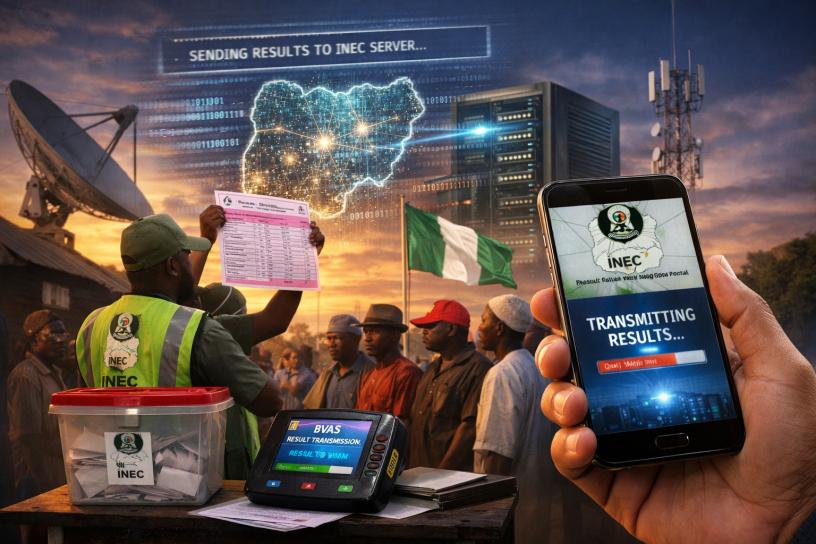
Nigeria’s Electoral Act 2026 has reopened one of the most contentious fault lines in the nation’s democratic journey:
whether election results should be transmitted electronically in real time from polling units to the Independent National Electoral Commission (INEC) server.
The Senate’s rejection of a clause that would make electronic transmission mandatory—while retaining INEC’s discretion to determine the mode of results transfer—has ignited a national debate that transcends technology. At its core, the controversy is about trust, transparency, and the credibility of Nigeria’s democratic institutions.
The Controversy Explained
The proposed amendment sought to compel presiding officers to electronically transmit polling-unit results directly to INEC’s Result Viewing portal (IReV) immediately after counting and signing of result forms. Lawmakers, however, voted against making it mandatory, arguing that the existing law already permits electronic uploads and that a rigid statutory mandate could constrain INEC’s flexibility, especially in areas with poor connectivity.
Opposition parties, civil society organisations, and many citizens viewed the decision as a setback to electoral transparency, arguing that mandatory real-time transmission would curb manipulation at collation centres and restore confidence in elections.
Practicability: The Nigerian Reality
Electronic transmission is not merely a political slogan; it is a technical and logistical undertaking. Nigeria’s electoral terrain presents unique challenges:
Infrastructure Gaps: INEC itself has acknowledged that weak telecommunications networks, especially in rural areas, remain the biggest obstacle to seamless real-time uploads.
Cybersecurity Risks: Experts caution that without robust digital resilience, electronic systems could be vulnerable to cyber attacks, misinformation, and sabotage.
Operational Constraints: Elections in Nigeria still rely on manual paper ballots, meaning results must be physically counted before any electronic upload, limiting the speed and feasibility of instant transmission
Yet, impracticability should not be conflated with impossibility. The debate is less about whether Nigeria can adopt electronic transmission and more about how quickly and securely it can scale the necessary infrastructure.
Global Best Practise: What Mature Democracies Do
Around the world, election management bodies increasingly use technology to enhance transparency, but with layered safeguards.
Key global practise include:
Hybrid Systems: Most democracies combine manual paper ballots with digital transmission to ensure auditability. Paper remains the gold standard for recounts and legal disputes.
Redundancy and Verification: Countries like India, Brazil, and Kenya transmit results electronically but retain parallel physical result sheets and audit trails to prevent system failures or fraud.
End-to-End Verifiability: Advanced democracies are exploring cryptographic verification systems that allow voters and observers to confirm that votes were recorded and counted correctly.
Gradual Implementation: Successful countries did not leap into full electronic transmission overnight; they piloted systems, built infrastructure, trained personnel, and strengthened legal frameworks before nationwide deployment.
Even technologically advanced jurisdictions have faced vulnerabilities in online voting systems, underscoring that technology is not a silver bullet but a tool that must be carefully governed.
The Democratic Dilemma
Nigeria’s debate is therefore emblematic of a broader democratic tension: flexibility versus enforceability.
Leaving electronic transmission at INEC’s discretion preserves operational flexibility but risks political interference and inconsistency. Making it mandatory strengthens transparency but demands heavy investment in infrastructure and cybersecurity.
In truth, both sides of the argument have merit. But democracy thrives on transparency, not discretion.
Way Forward: Reform with Responsibility
Nigeria must move beyond binary arguments and embrace a pragmatic reform pathway:
- Phased Mandate:
Legislate a progressive timeline for mandatory electronic transmission, beginning with federal elections and urban centres, expanding nationwide as infrastructure improves. - Infrastructure Investment:
Partner with telecom companies, satellite providers, and tech firms to guarantee nationwide election-day connectivity, including offline-upload mechanisms with secure time-stamping. - Legal Safeguards:
Embed penalties for failure to transmit results electronically where infrastructure is available, while protecting presiding officers in genuinely disconnected areas. - Cybersecurity Architecture:
Establish an independent electoral cybersecurity agency and subject INEC systems to periodic third-party audits. - Public Transparency:
Ensure that polling-unit results uploaded electronically are immediately accessible to parties, observers, and citizens, reinforcing public trust. - Institutional Trust-Building:
Technology cannot replace institutional integrity. Strengthening INEC’s independence and accountability remains the ultimate guarantor of credible elections.
Conclusion:
Technology as a Democratic Imperative
The controversy over electronic transmission is not a technical footnote; it is a referendum on Nigeria’s democratic ambition.
Every reform in electoral technology is ultimately a statement of political will. Nations that fear transparency resist it; nations that embrace democratic consolidation institutionalise it.
Nigeria stands at a crossroads. The choice is not between tradition and technology, but between opacity and openness. History will judge whether the Electoral Act 2026 was a missed opportunity or the beginning of a phased democratic renaissance.
Abdul Kezo IkonAllah is a public affairs analyst and commentator on governance, democracy, and political economy.
In the digital age, democracy is not just counted—it is transmitted
Discover more from IkonAllah's chronicles
Subscribe to get the latest posts sent to your email.
