
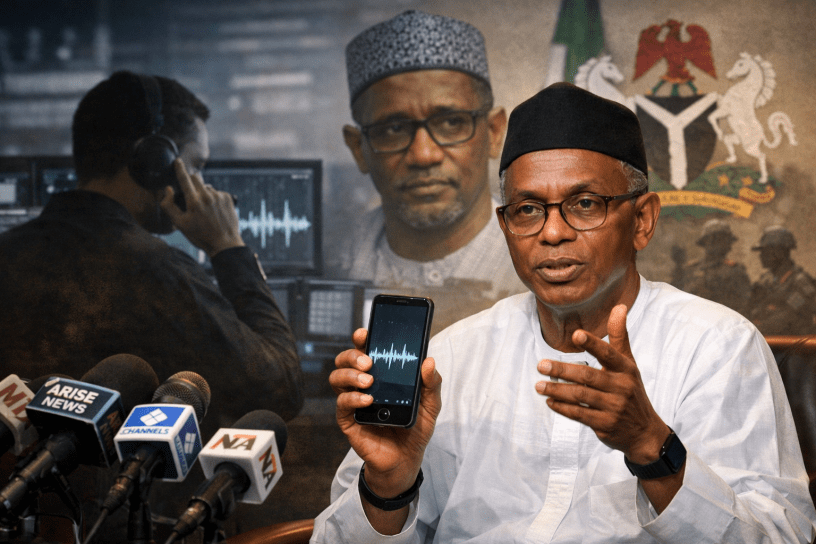
When former Kaduna State Governor Nasir El-Rufai appeared on national television and claimed that his associates intercepted phone conversations involving Nigeria’s National Security Adviser, Nuhu Ribadu, it sent shockwaves through the country’s political and security establishment.
The allegation — that he became aware of a planned arrest through tapped communications linked to the NSA — is extraordinary. But beyond the immediate drama lies a deeper set of questions about legality, state power, political rivalry and institutional trust.
The Claim and Its Weight
El-Rufai suggested that his camp had “ways” of knowing about security plans targeting him, including access to intercepted communications. By his own admission, such actions would ordinarily be illegal. That acknowledgement alone shifts the matter from political rhetoric into potential legal exposure.
In any democratic system, unauthorised interception of private or official communications is a serious offence. Nigeria’s cybercrime and telecommunications laws do not make room for political exceptions. If the claim is literal, it raises concerns about the capability and willingness of private actors to penetrate state security communications. If it is exaggerated or rhetorical, it still risks undermining public confidence in critical institutions.
Legal Implications: A Double-Edged Sword
The situation presents a paradox:
If the interception occurred, those responsible may have violated the law.
If it did not occur, and the claim is unfounded, it could amount to a reckless allegation against a senior national security official.
Either scenario carries consequences.
For the Office of the National Security Adviser, silence may protect operational confidentiality, but prolonged silence can also fuel speculation. For El-Rufai, the public admission could attract scrutiny from investigative or prosecutorial authorities. In this sense, the claim is politically explosive but legally delicate.
The Political Undercurrent
This controversy cannot be separated from Nigeria’s current political climate. El-Rufai, once a powerful figure within the ruling establishment, has increasingly found himself at odds with elements of the federal power structure. His remarks may be read by supporters as a pre-emptive move — framing any future legal action against him as political persecution rather than due process.
Critics, however, argue that invoking intercepted calls without presenting evidence risks normalising conspiracy politics at the highest level.
With 2027 already looming in political calculations, narratives of victimhood and institutional overreach can become powerful mobilisation tools.
Institutional Trust at Stake
The more profound issue may be institutional credibility. If Nigerians begin to believe that:
Senior security officials are secretly plotting political arrests, or
Political actors can freely intercept top-level security communications,
then confidence in governance structures erodes from both ends.
Security agencies depend on public trust to function effectively. Political actors depend on institutional legitimacy to sustain democratic competition. Claims of clandestine interceptions — whether factual or exaggerated — weaken both.
The Bigger Democratic Question
Democracies thrive on accountability, but accountability must operate through lawful channels. If El-Rufai possesses evidence of abuse of office, the appropriate venue is investigative and judicial mechanisms, not televised insinuation. Conversely, if the state believes laws were broken through illegal surveillance, it must pursue the matter transparently and within constitutional bounds.
Nigeria’s political class often wages battles in the court of public opinion. Yet when disputes involve national security infrastructure, the stakes are higher than partisan advantage.
Conclusion
El-Rufai’s televised assertion has done more than spark headlines. It has opened a conversation about surveillance, state authority, elite rivalry and the fragility of institutional trust.
Whether this episode ends in legal proceedings, quiet de-escalation, or continued rhetorical warfare will depend on how both sides navigate the fine line between politics and the rule of law.
What is clear is this: when allegations of intercepted national security communications enter public discourse, the issue is no longer personal. It becomes a test of Nigeria’s democratic maturity and institutional resilience.
Discover more from IkonAllah's chronicles
Subscribe to get the latest posts sent to your email.
