
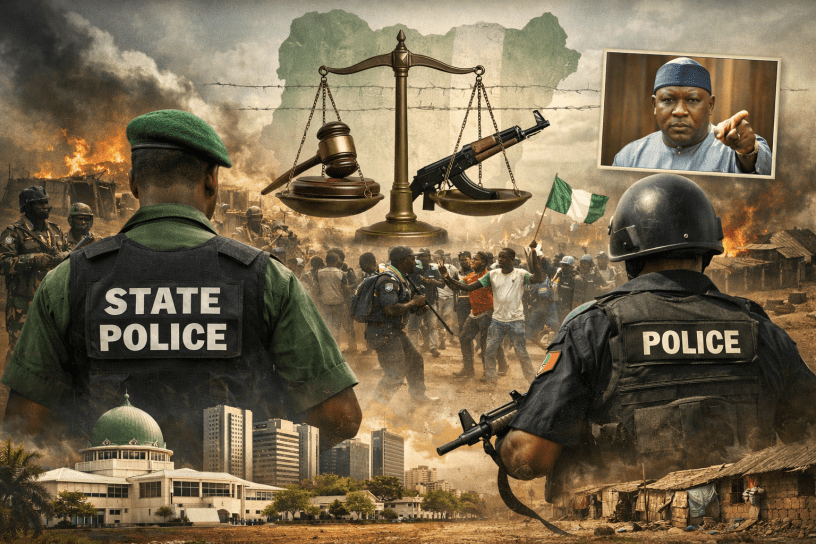
Nigeria is facing one of the most severe security crises in its modern history. From the forests of the Northwest where armed bandits terrorise rural communities, to the deadly farmer–herder conflicts in the Middle Belt, and the persistent tensions in the Southeast, insecurity has become a defining national challenge.
In response, a long-standing policy debate has resurfaced with renewed urgency: Should Nigeria establish state police forces?
The idea itself is not new. For years, advocates of restructuring Nigeria’s security architecture have argued that the country’s highly centralised policing system is no longer fit for purpose. But while the case for decentralisation appears logical, the risks associated with it cannot be ignored.
The question, therefore, is not simply whether Nigeria needs state police. It is whether the country’s political and institutional environment is ready for it.
The Argument for State Police
Supporters of state police often begin with a straightforward point: security challenges are best addressed by authorities closest to the communities affected.
Nigeria’s federal police force is overstretched. With roughly 400,000 officers responsible for policing a population exceeding 220 million people, the ratio is far below international recommendations. Beyond the numbers, the centralised command structure makes rapid and localised responses difficult.
When insecurity escalates in a state today, governors — constitutionally designated as the “chief security officers” of their states — do not actually command the police operating within their territory. Instead, they must appeal to federal authorities in Abuja for reinforcements or intervention.
This bureaucratic chain of command often leads to delayed responses at moments when speed is critical.
Another argument in favour of state policing relates to local intelligence. Effective law enforcement depends on understanding the communities being policed — their languages, customs, local disputes, and criminal networks.
A locally recruited police force would likely have deeper community knowledge and stronger trust relationships with residents. Such proximity could improve intelligence gathering and enhance preventive policing.
There is also a constitutional argument grounded in federalism. In many federations around the world, subnational governments play a significant role in policing. Granting states greater responsibility over security, proponents argue, would bring Nigeria closer to the principles of true federal governance.
The Concerns
Despite these arguments, the scepticism surrounding state police is both understandable and legitimate.
Nigeria’s political history provides numerous examples of institutions being used for partisan purposes. Elections have sometimes been accompanied by intimidation, violence, and the misuse of state authority.
Critics worry that placing armed police forces directly under the authority of governors could open the door to politicised policing.
In states where political competition is intense, a governor-controlled police force could potentially be used to harass political opponents, silence critical voices, or intimidate journalists and activists.
The fear of “governorship armies” is therefore not entirely unfounded.
Another serious concern relates to economic inequality between states. Nigeria’s states vary widely in their fiscal capacity. Wealthier states such as Lagos could likely build well-equipped, professional police forces, while poorer states might struggle to maintain even basic operational standards.
If not carefully designed, decentralisation could result in a two-tier security system where the quality of policing varies significantly depending on where a citizen lives.
Moving Beyond the Binary Debate
Too often, the discussion around state police is framed as a simple choice: maintain the current federal police system or adopt state policing.
But the more productive question is this: under what conditions could state police improve security without undermining democratic freedoms?
If Nigeria is to move in this direction, strong institutional safeguards will be essential.
These safeguards could include independent state-level police service commissions with the power to discipline officers, clear legal restrictions against the political deployment of police personnel, and transparent recruitment processes that prioritise professionalism over patronage.
There must also be mechanisms for federal oversight and financial support to ensure that poorer states are not disadvantaged.
Equally important are robust accountability frameworks that allow civil society organisations, the media, and ordinary citizens to monitor policing practices and report abuses without fear of reprisal.
Without these protections, decentralising the police could simply replicate existing problems at multiple levels of government.
A Careful Reform
There is little doubt that Nigeria’s current policing structure faces serious limitations. The scale and complexity of the country’s security challenges make it increasingly difficult for a single centralised force to respond effectively everywhere at once.
Yet institutional reforms of this magnitude must be approached with caution.
Rushing constitutional amendments without building the necessary accountability systems could create new problems while attempting to solve old ones.
The voices of ordinary Nigerians — farmers in Benue, traders in Kano, students in Enugu — must remain central to the conversation. After all, they are the citizens whose safety and freedoms are ultimately at stake.
The real question facing Nigeria is not whether state police could improve security.
It is whether the country can design a system that strengthens safety without weakening democracy.
That is a question that demands careful thought — not hurried decisions.
Abdul Ibrahim Abdul Kezo IkonAllah is a public relations professional and public affairs commentator who writes on governance, security, and public policy.
Abdul Ibrahim IkonAllah is a public relations professional and public affairs commentator who writes on governance, security, and public policy.
Discover more from IkonAllah's chronicles
Subscribe to get the latest posts sent to your email.
