
By Abdul Kezo
Public Relations Professional, Public Affairs Analyst, and New Media Specialist
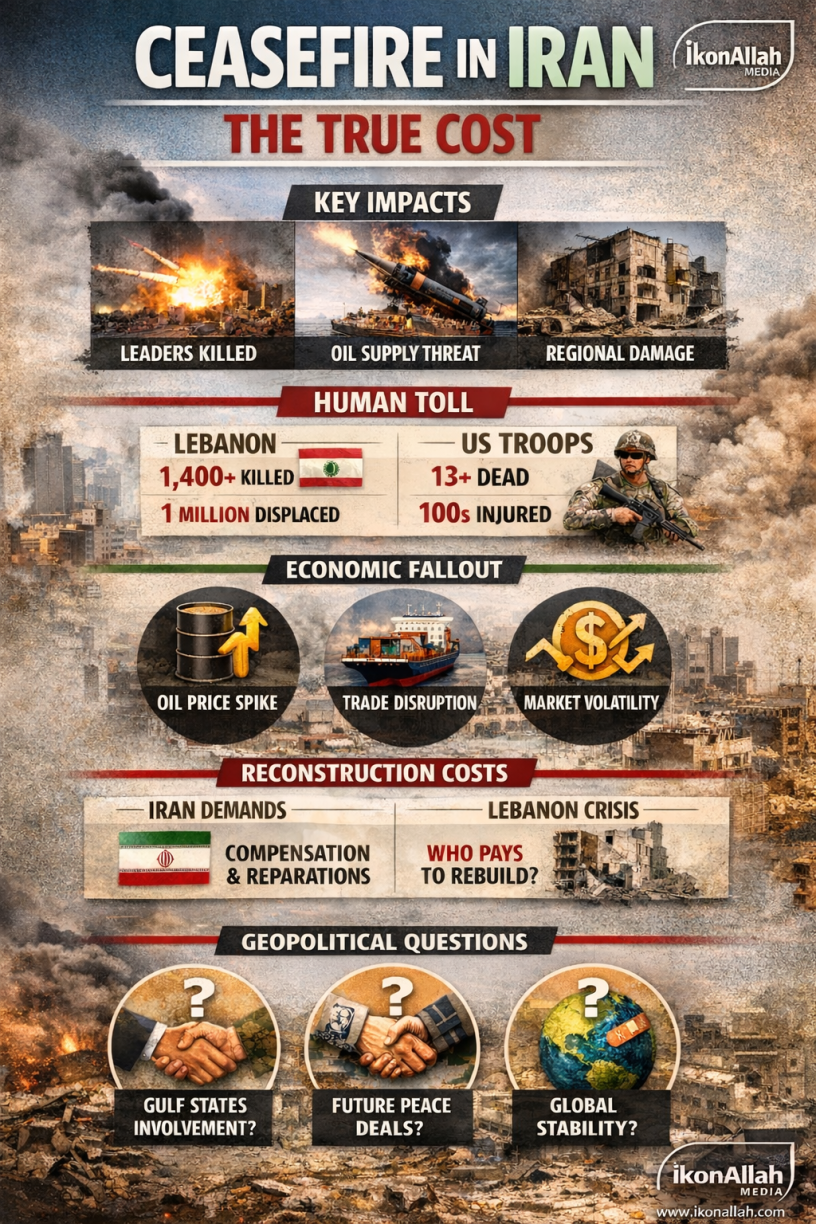
The announcement of a ceasefire in the Iran conflict is, without doubt, a welcome development. After weeks of heightened tensions, targeted strikes, leadership decapitation, regional proxy engagements, and threats to strategic energy corridors, the truce offers a much-needed pause in what had become one of the most consequential geopolitical crises of the decade.
Yet, beyond the immediate relief that accompanies the guns falling silent, the real question remains: what has this war cost the region and the world, and who truly bears the burden of rebuilding peace?
At first glance, the ceasefire appears to represent a diplomatic victory for all sides. Iran has survived politically despite the targeted killing of senior military and state figures. The United States and its allies have secured a temporary halt to further escalation. Pakistan, by providing a crucial diplomatic off-ramp, has emerged as a significant mediator, offering Washington and Tehran a face-saving route away from a prolonged confrontation.
However, the wider implications go far beyond the battlefield.
One of the most immediate impacts of the ceasefire is on the global economy, particularly the energy market. During the conflict, fears over disruptions in the Strait of Hormuz — through which a substantial share of the world’s crude oil and liquefied natural gas passes — triggered volatility in global commodity markets. Oil prices surged on concerns that supply chains could be severed, sending ripple effects across inflation-sensitive economies from Europe to Asia and Africa.
For oil-importing nations, especially developing economies, every rise in crude prices translates into higher transportation costs, rising food prices, and increased pressure on foreign exchange reserves. Countries already battling inflation, debt stress, and currency instability faced the prospect of further economic hardship.
The ceasefire therefore brings immediate economic relief.
A de-escalation in hostilities is likely to stabilize global crude prices, ease pressure on shipping insurance premiums, and restore confidence in maritime trade routes through the Gulf. This is particularly significant for import-dependent nations like Nigeria, where fluctuations in global oil prices influence both government revenue projections and the cost of refined petroleum imports.
Financial markets, which had reacted nervously to the conflict, are also expected to respond positively to signs of stability. Investor confidence typically improves when geopolitical risks diminish, leading to calmer stock, commodity, and currency markets.
But the economic implications do not end there.
The war has left behind enormous reconstruction needs. Iran’s damaged infrastructure, Lebanon’s devastated communities, and the losses suffered by Gulf states and allied positions will require billions of dollars in rebuilding efforts. Roads, energy facilities, public institutions, housing, and health infrastructure across affected zones will need urgent restoration.
This raises a difficult geopolitical question: who pays?
Will international donors step in?
Will Gulf states finance reconstruction in Lebanon?
Will reparations become part of future negotiations?
Or will the burden fall on already strained national economies?
In Lebanon’s case, the challenge is even more severe. The country, already weakened by prolonged economic crisis, cannot independently shoulder the scale of post-war reconstruction. External assistance will be inevitable, but such aid is rarely divorced from political conditions.
From a broader strategic perspective, the ceasefire may have stopped active hostilities, but it has not resolved the deeper contest for influence across the Middle East. Iran, the Gulf states, Israel, the United States, and regional actors will all continue recalibrating their positions.
This is why it is premature to speak in terms of absolute winners and losers.
Militarily, all sides have suffered losses.
Economically, the world has paid a price.
Humanitarianly, civilians remain the greatest victims.
The ceasefire should therefore be seen not as the end of the crisis, but as the beginning of a more complex phase — one defined by diplomacy, reconstruction, economic stabilization, and the long struggle to rebuild trust in a region long scarred by conflict.
The world may welcome the silence of the guns today, but history will judge what follows next.
The true test of peace is not the ceasefire itself, but whether it restores stability to the region and confidence to the global economy.
Discover more from IkonAllah's chronicles
Subscribe to get the latest posts sent to your email.
