
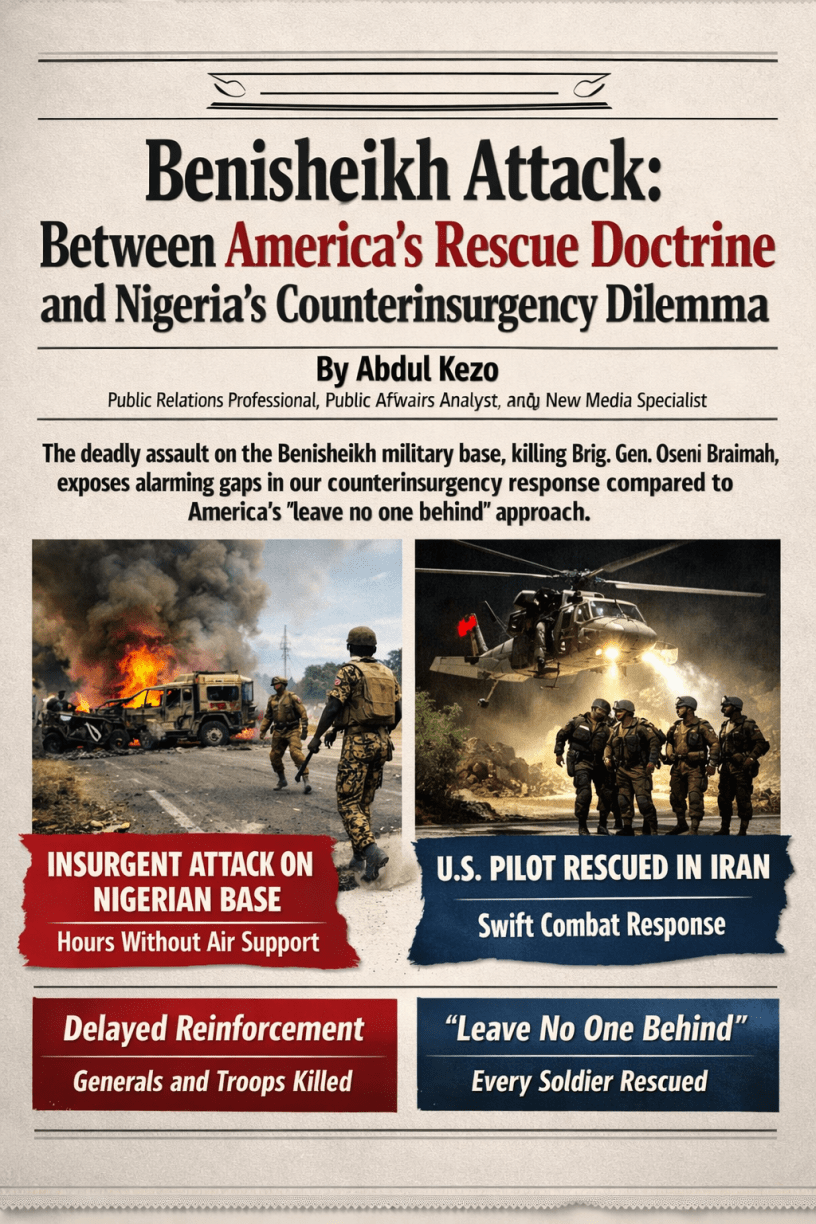
Standfirst: The prolonged insurgent assault on a strategic military base in Benisheikh exposes critical weaknesses in Nigeria’s rapid-response doctrine and raises urgent questions about intelligence, reinforcement, and air support.
The deadly insurgent attack on the military formation in Benisheikh, Borno State, which reportedly claimed the life of Brigadier General Oseni Omoh Braimah alongside other gallant officers and soldiers, is more than another painful entry in Nigeria’s long war against terror. It is a disturbing reminder of the persistent operational gaps that continue to undermine the country’s counterinsurgency campaign.
What makes the tragedy particularly difficult to comprehend is its location.
Benisheikh lies on the strategic federal highway linking Maiduguri to Damaturu — a critical security and logistics corridor in the North-East. This is a major route that should ordinarily benefit from layered surveillance, rapid troop mobility, and immediate air support readiness.
Yet insurgents reportedly operated for close to five hours, inflicting heavy casualties before disappearing once again into the surrounding terrain.
That reality raises a painful but unavoidable question: how can a military base on such a strategic highway remain under sustained assault for hours without decisive reinforcement, especially air support?
The contrast with recent events involving the United States in Iran is striking.
When an American fighter jet was shot down over hostile territory, U.S. forces immediately launched an aggressive combat search-and-rescue mission. Within hours, air and ground assets were mobilized to recover personnel, demonstrating a doctrine that no soldier is left behind.
This is the essence of strategic military confidence.
America’s response was swift, coordinated, and unapologetically forceful.
By contrast, Nigeria’s response to repeated insurgent attacks on military formations often appears reactive rather than pre-emptive.
Bases come under prolonged attack. Senior officers are killed. Troops fall in alarming numbers. Reinforcements either arrive late or are constrained by poor intelligence, ambush risks, and inadequate air cover.
Then, almost predictably, the attackers disappear.
This recurring cycle is what continues to baffle and frustrate many Nigerians.
The issue is not to romanticize foreign militaries but to ask why a country battling insurgency for over a decade still appears unable to guarantee immediate response capability along one of its most important military corridors.
The repeated killing of senior officers is even more troubling.
This is reportedly the second general lost in recent months, in addition to several commanding officers and numerous troops across the theatre of operations.
Such losses strike at the heart of command structure, troop morale, and national confidence.
The Benisheikh incident must therefore compel a serious strategic review.
Nigeria must strengthen intelligence gathering, persistent aerial surveillance, rapid reaction forces, dedicated combat air support readiness, and real-time communication between ground formations and air assets.
The lesson from America’s rescue doctrine is not merely about superior firepower.
It is about institutional urgency, coordination, and the value placed on military personnel.
A nation at war must show its troops that when they are under attack, help is never hours away.
The sacrifice of the fallen officers and soldiers in Benisheikh must not become another routine condolence statement.
Their deaths should force urgent reforms in how this war is fought.
Because if a strategic base on the Maiduguri–Damaturu highway can be overrun for hours, then the challenge before Nigeria is no longer simply insurgency — it is the urgent need to rethink the doctrine, speed, and seriousness of our national security response.
By Abdul Kezo IkonAllah
Public Relations Professional, Public Affairs Analyst, and New Media Specialist
Discover more from IkonAllah's chronicles
Subscribe to get the latest posts sent to your email.
