
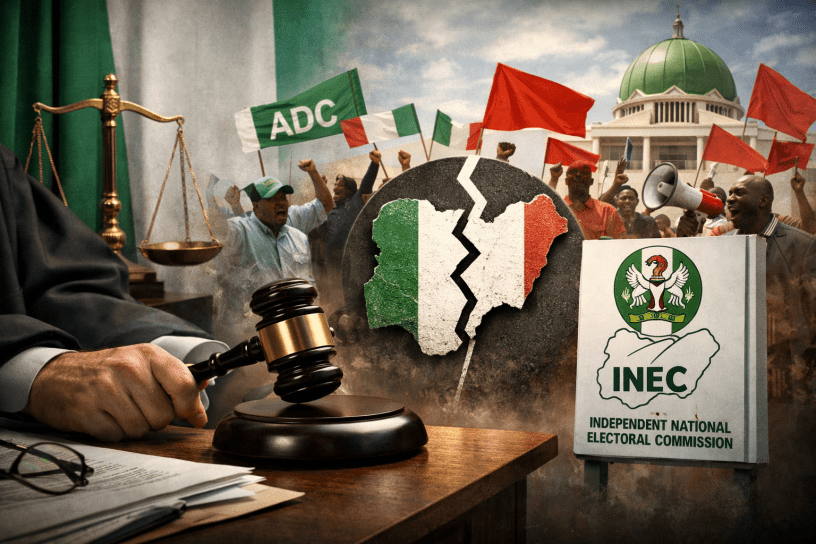
Nigeria’s democratic trajectory has once again come under scrutiny as court cases continue to bedevil opposition political parties at a critical period in the electoral calendar. With timelines for congresses, conventions, primaries, and candidate submissions steadily approaching, the implications of these legal disputes extend far beyond internal party affairs. They raise profound questions about electoral competitiveness, institutional balance, and the future of multiparty democracy in the country.
The crisis surrounding opposition parties, particularly the African Democratic Congress (ADC), illustrates how litigation can become a major political variable. Where the leadership structure of a party is under judicial contest, every action taken by that party—whether a congress, convention, or primary election—risks being invalidated if later found to have been undertaken by an improperly recognized executive. In practical terms, this means that even if the party mobilizes effectively, it may still face disqualification through the courts.
The concept of status quo ante bellum, now central to the dispute, has introduced further complexity. By restoring the state of affairs that existed before the disputed actions, the court order effectively freezes the party’s recognized leadership and administrative processes pending determination of the substantive suit. INEC’s interpretation of this order, particularly its refusal to recognize any faction or receive official communications until judicial clarity emerges, creates a serious administrative bottleneck for the opposition.
This has immediate electoral implications. Political parties are bound by strict timelines laid down by the electoral commission. Failure to meet these deadlines may result in the inability to field candidates for key offices. For the ADC, the risk is existential: a prolonged legal stalemate could render the party organizationally inactive at the precise moment it needs to consolidate its national structure and prepare for the next general election.
Yet the prospects of the ADC are not entirely bleak. Much will depend on the speed with which the courts resolve the matter. If the judiciary moves swiftly—through accelerated hearing or clarification of the order—the party may still recover sufficient time to conduct valid congresses and primaries. In this scenario, ADC could emerge stronger, possibly benefiting from public sympathy as a party seen to be fighting institutional constraints.
However, should the order remain in place without timely judicial relief, the party must consider strategic alternatives. First, it should seek urgent legal clarification on whether routine party administration and preparatory political activities may continue without violating the court’s directive. Second, it should prioritize internal reconciliation among contending factions, since many political disputes in Nigeria are ultimately resolved through negotiated settlements rather than prolonged courtroom battles. Third, the party may need to keep contingency options open, including coalition-building or strategic alliances with other opposition platforms.
The broader democratic implications are even more significant. A healthy democracy requires a vibrant and functional opposition. When opposition parties become trapped in litigation, the electorate is deprived of credible alternatives, and the political field tilts disproportionately in favor of incumbents. This risks fostering a dominant-party environment in which elections continue to hold, but meaningful competition is diminished.
Equally troubling is the increasing judicialization of politics in Nigeria. Courts are meant to uphold legality and constitutional order, but when political outcomes are repeatedly determined in courtrooms rather than through party mechanisms and electoral processes, public confidence in democratic institutions may erode. Voters may begin to see politics as a contest of legal technicalities rather than popular mandate.
In the final analysis, the crisis facing opposition parties is not merely a legal problem; it is a test of Nigeria’s democratic resilience. The fate of the ADC may well serve as a barometer for how inclusive, competitive, and robust the nation’s political system remains in the lead-up to future elections.
Abdul kezo IkonAllah
Public Relations Professional, Public Affairs Analyst, and New Media Specialist
Discover more from IkonAllah's chronicles
Subscribe to get the latest posts sent to your email.
