
Abdulkezo IkonAllah
A nation reveals the value it places on human life through the way it remembers its dead. Families who lose loved ones to violence, disasters or public service deserve more than condolences delivered while a tragedy remains in the headlines. They deserve lasting recognition, an honest record of what happened and evidence that lessons have been taken seriously.
The debate surrounding the 20 October 2020 Lekki tollgate shooting raises a broader question about Nigeria’s approach to remembrance. How should the country preserve the memory of people lost in national tragedies? How should it honour security personnel who die protecting others? These questions concern our history and the relationship between citizens and the state.
The conversation must extend to victims of Boko Haram and other terrorist attacks, farmer–herder violence, banditry and communal killings. It must include people lost to floods, building collapses, fires and other disasters, as well as road crashes, boat accidents and aviation tragedies. Their circumstances differ, but every affected family deserves dignity. A person’s place in our national memory should not depend on where they lived or how much publicity their death attracted.
The Lagos judicial panel that investigated the Lekki incident recommended making the toll plaza a memorial site and renaming it EndSARS Tollgate. That recommendation recognised the importance of preserving the location’s historical meaning. Whether considering Lekki or another tragedy, remembrance should be approached as a public responsibility, with families and survivors central to the process.
It would be inaccurate to suggest that Nigeria has no tradition of honouring sacrifice. Armed Forces Remembrance Day, observed on 15 January, and ceremonies at the National Arcade in Abuja provide an established foundation. The challenge is to deepen that culture and ensure that civilians affected by national tragedies, alongside fallen personnel across the security and emergency services, receive sustained and appropriate recognition.
The Nigerian Civil War of 1967 to 1970 also deserves an inclusive national memorial. The National War Museum in Umuahia provides an existing foundation for preserving this history. Building on such institutions, a national memorial should acknowledge civilian suffering and those who died on both sides, with space for testimony from survivors, veterans and affected communities. Carefully researched accounts of displacement, hunger and bereavement would help younger Nigerians understand the human consequences of the conflict.
Such a memorial could support reconciliation by recognising different experiences and allowing difficult questions to be examined honestly. Where individual names cannot be recovered, collective acknowledgement should ensure that undocumented victims are remembered. Historians and affected communities should help shape its content, with links to regional memorials and archives.
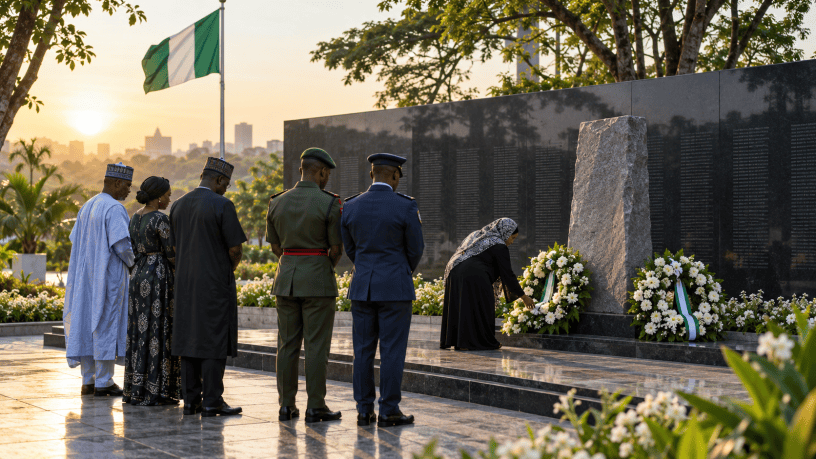
Memorials give families a place to mourn and a public acknowledgement that their loved ones mattered. A name engraved on a wall, accompanied where appropriate by a photograph or short biography, restores individuality to people otherwise remembered only through casualty figures. It helps the wider society understand the human cost of events that can become distant political arguments.
They also preserve history. Without accessible records, younger Nigerians may encounter major events through competing social media accounts, rumours or selective recollections. A properly managed memorial can bring together verified documents, testimony and historical context. It should distinguish established facts from unresolved questions and allow records to be corrected when credible new evidence emerges.
Other countries offer useful examples. New York’s National September 11 Memorial and Museum combines remembrance with historical collections, educational resources and engagement with affected families, survivors and rescue workers. Nigeria need not copy its scale or architecture. The useful principle is to connect a physical place of remembrance with records, learning and continuing support for those affected.
Rwanda offers an especially relevant African example. The Kigali Genocide Memorial preserves the history of the 1994 genocide against the Tutsi and combines commemoration with education. It is also included in Rwanda’s official visitor information. Its remembrance and learning tours have supported memorial activities, education and survivor programmes. This demonstrates how respectful visits can help sustain remembrance.
Nigeria could develop educational and heritage tourism around well-managed memorials, with school visits, research programmes and guided historical tours. This could create opportunities for trained local guides, archivists and surrounding businesses, while helping visitors understand the country beyond its headlines. Any revenue should support preservation and community benefit. Bereaved families should help shape visitor conduct, photography rules and interpretation so that dignity remains central.
For security institutions, remembering personnel killed in the line of duty makes the meaning of service visible. Soldiers, police officers and other personnel leave families and communities behind. Public recognition should acknowledge their individual lives and the circumstances of their service. Honouring them is compatible with demanding lawful conduct and accountability from the institutions to which they belonged.
Why, then, does remembrance sometimes receive inadequate attention? Politically sensitive tragedies can make official recognition uncomfortable, particularly where questions remain about institutional responsibility. Changes of government can interrupt commitments. Fragmented records and unclear maintenance responsibilities can also weaken memorial projects. These are problems to address through durable arrangements that do not depend on the enthusiasm of one officeholder.
Nigeria should begin with a national framework for remembrance, developed through consultation with bereaved families, survivors, historians, affected communities and relevant public institutions. It should establish clear criteria for public memorials and explain how proposals are assessed. Selection should reflect the significance of an event and the needs of affected people, rather than political connections or media attention alone.
The National Commission for Museums and Monuments (NCMM) should play a central technical role in implementation. Its existing responsibilities include documentation, conservation, research and public education through cultural heritage. With adequate resources and an agreed framework, the commission could develop standards for memorial collections and exhibitions, advise on site preservation and train local custodians. It could also support the proposed Civil War memorial and help link local collections through a shared digital catalogue.
Implementation should involve state governments, archives, universities and affected families, with clear responsibilities and public reporting. NEMA and state emergency management agencies could contribute disaster records. The Federal Road Safety Corps could support documentation of road crash victims, while security agencies and affected communities could help verify losses arising from violence and service. Appropriate safeguards must protect survivors and sensitive information. The immediate task is to assign responsibility, publish standards and provide funding that can be traced.
Reliable documentation must come before permanent inscriptions. A register should record verified names, available biographical details and the sources supporting each entry. Families should have an accessible way to submit information, request corrections and decide whether sensitive details are made public. Missing persons and disputed cases require clearly explained treatment; uncertainty must never become an excuse to erase a person’s story.
Families and survivors should help determine the location, design and language of each memorial. Their involvement must begin before a design is approved. Some communities may prefer a garden or wall of names; others may want a small museum, a digital archive or preservation of an existing site. Religious practices, disability access and the safety of visitors should shape those choices.
Affected farming and pastoral communities should both have meaningful representation where relevant. Memorial language must identify victims accurately without assigning collective blame to an ethnic or religious group.
Costs should be proportionate. A modest, carefully maintained memorial can serve the public better than an expensive structure left to deteriorate. Every approved project should identify its custodian, construction budget, annual maintenance allocation and sources of funding. Procurement information and expenditure reports should be public. Private donations may help, but donors should have no authority to rewrite the historical account.
Remembrance must also lead to learning. Schools should have access to age-appropriate material developed with historians and educators. Memorial exhibitions can explain the circumstances of a tragedy and the reforms recommended afterwards.
Lessons should be specific. Road crash memorials should support attention to safer roads and emergency care. Disaster memorials should encourage scrutiny of early warnings, building safety and evacuation arrangements. Memorials to victims of violence should sustain attention to civilian protection and justice. Anniversary observances should include public updates on relevant safety improvements, outstanding recommendations and support for affected families. Peaceful remembrance gatherings should be facilitated with appropriate arrangements for public safety.
A practical first year could begin with an audit of existing memorials and records, followed by public consultation and publication of the framework. A small number of pilot projects could then test the process in different regions, covering conflict, disasters, transport tragedies and service deaths.
Community walls of names and a shared digital archive would allow wider recognition without requiring a separate major monument for every incident. Their success should be measured by accuracy, family participation, accessibility and maintenance, alongside progress on the lessons each event demands.
Above all, a monument must never be treated as settlement of a family’s claim to justice. Compensation, medical care, counselling, survivors’ support and benefits owed to the dependants of fallen personnel must proceed on their own merits. An unveiling ceremony cannot discharge those responsibilities.
Nigeria should make remembrance a dependable part of public life. When we preserve names and tell difficult stories honestly, we give future generations the evidence with which to question failures and recognise sacrifice. The strongest tribute is a lasting place in our history, supported by action that reduces the chance of another family suffering the same loss.
Abdul is a public policy affairs analyst, PR professional and New Media specialist
Discover more from IkonAllah's chronicles
Subscribe to get the latest posts sent to your email.
