
IKONALLAH MEDIA | PUBLIC AFFAIRS & POLITICAL ANALYSIS | FRIDAY, 13 NOVEMBER 2026
Nigeria is once again approaching a defining democratic moment, but disturbing developments across the country suggest that the road to the 2027 general elections may be increasingly dangerous. Instead of allowing ideas, policies and competing visions for national development to dominate the political space, violence, intimidation and attacks on political gatherings are beginning to overshadow the electoral conversation.
With barely two months to the presidential election, the warning signs are becoming too serious to ignore.
Democracy cannot flourish where political opponents are treated as enemies, where thugs determine who can campaign, and where citizens must risk their lives to exercise their constitutional rights.
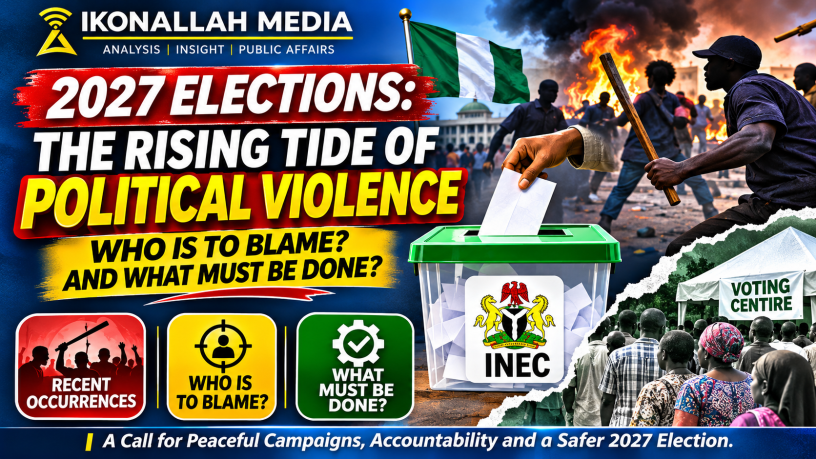
Recent Occurrences: A Disturbing Pattern
The November 12 attack on a Nigeria Democratic Congress (NDC) town hall gathering in Oregun, Lagos, represents one of the latest troubling incidents. Suspected political thugs reportedly disrupted the event, attacked supporters and damaged property. A suspect was arrested, while allegations and counter-allegations followed between political interests.
The Lagos chapter of the ruling All Progressives Congress (APC) denied involvement, while the party’s presidential campaign council condemned the violence and called for the arrest and prosecution of those responsible. The identity of those who organised or sponsored the attack has not been independently established. The Guardian Nigeria +1
Lagos is not an isolated case.
On November 4, Peter Obi’s convoy was reportedly attacked in Calabar, Cross River State. In Asaba, Delta State, a November 7 political rally turned deadly, with police confirming one death and five injuries. Other reported incidents in Edo, Rivers and several states point to a worrying pattern of attacks on political gatherings, party offices and supporters. Premium Times Nigeria +1
Perhaps even more alarming is an election security assessment cited by civil society organisations, which recorded 70 physical election-related incidents across 19 states and the Federal Capital Territory between January and October 27, including 27 deaths.
These figures should trouble every Nigerian, irrespective of political affiliation. Premium Times Nigeria
Who Is to Blame?
The responsibility for this growing atmosphere of political hostility cannot be placed on ordinary Nigerians alone.
First, political leaders and their supporters must accept responsibility for the environment they create. When political competition is framed as a battle for survival, inflammatory statements and intolerance can encourage supporters to regard violence as an acceptable political weapon.
Those who recruit, finance or protect political thugs must be exposed and prosecuted, regardless of their political party. However, allegations against particular parties or politicians must be established through credible investigation rather than assumed to be true.
Second, security agencies have serious questions to answer. Why are political gatherings repeatedly vulnerable to attacks? Why are threats not always prevented before violence erupts? And why does the public so rarely see clear, timely conclusions to investigations into politically motivated attacks?
The Nigeria Police Force and other security institutions must demonstrate that protecting political rights is a constitutional obligation, not a favour granted to whichever party controls government.
Third, political parties themselves must confront the culture of intolerance. Every party has a responsibility to discipline violent supporters, reject intimidation and ensure that its campaign structures do not become instruments of harassment.
Finally, citizens and social media actors must recognise the danger of spreading unverified allegations, inflammatory propaganda and provocative content capable of turning political disagreement into physical confrontation.
Political loyalty must never become an excuse for criminal behaviour.
What Must Be Done?
The time for routine condemnations and politically convenient statements is running out.
The Federal Government, security agencies, the Independent National Electoral Commission (INEC), political parties and civil society organisations must act decisively.
There must be independent and transparent investigations into recent attacks, followed by credible prosecution of those responsible. Security protection must be available to all lawful political gatherings without discrimination.
INEC should work with security agencies and political parties to strengthen election security arrangements, identify high-risk locations and establish clear procedures for responding to intimidation and violence.
Political leaders must publicly commit to peaceful campaigns and hold their supporters accountable. The media, religious institutions, traditional leaders and civil society groups must intensify voter education and reject the dangerous normalisation of political thuggery.
The House of Representatives’ decision to investigate rising political violence is a welcome development, but its value will ultimately depend on the seriousness of its findings and whether meaningful action follows. TheCable
Above all, there must be consequences for electoral violence. Without accountability, condemnation becomes another empty political ritual.
The Way Forward: Democracy Must Prevail
The 2027 elections should be a contest of ideas, competence, character and leadership, not a battlefield where political ambition is pursued through fear and bloodshed.
Nigerians are already confronting enormous economic, security and social challenges. The last thing the country needs is an electoral process that deepens division, destroys lives and weakens public confidence in democratic institutions.
The ruling party has a special responsibility to ensure that the machinery of government protects every citizen equally. Opposition parties, too, must conduct their campaigns responsibly and resist the temptation to retaliate against intimidation with violence.
No political ambition is worth the life of a Nigerian. No candidate is bigger than the Constitution. And no political party should enjoy immunity from the law.
As January 16, 2027 approaches, the critical question is no longer whether political violence threatens Nigeria’s democracy. The evidence suggests that it already does.
The real question is whether those entrusted with protecting our democratic institutions possess the political will to stop it before the situation deteriorates further.
History will judge not only those who perpetrate political violence but also those who possess the authority to prevent it and choose to remain silent.
Nigeria must choose ballots over bullets, dialogue over intimidation, and democracy over desperation.
The time to act is now.
Abdul IkonAllah is a PR professional, social media specialist and public affairs analyst.
Discover more from IkonAllah's chronicles
Subscribe to get the latest posts sent to your email.
