
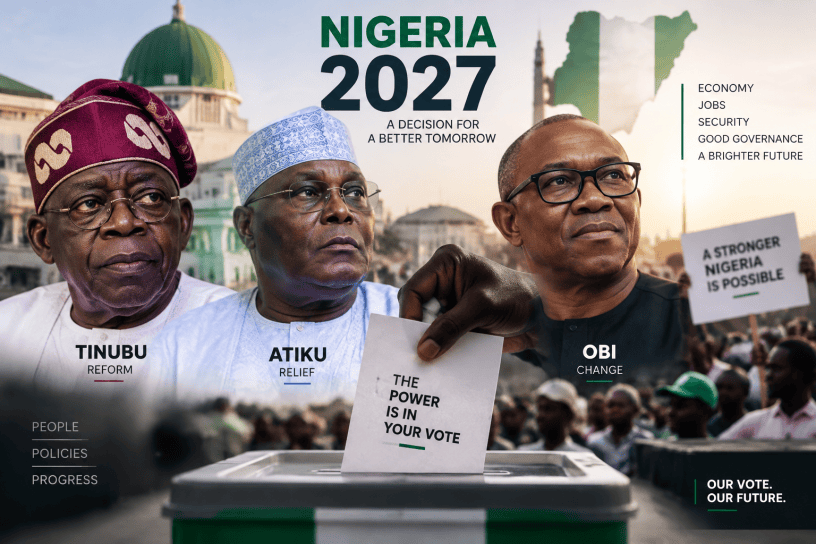
Nigeria’s 2027 presidential election will be shaped by three major issues: the economy, public trust and the credibility of the political alternatives before voters.
For millions of Nigerians, the election will not be decided by political slogans but by daily realities — food prices, fuel costs, electricity tariffs, jobs and living standards.
The contest is expected to centre around President Bola Ahmed Tinubu of the APC, former Vice President Atiku Abubakar, and Peter Obi of the Nigeria Democratic Congress (NDC).
Each candidate represents a different message: reform, relief and change.
Tinubu: The Reform Test
President Tinubu’s strongest argument will be that difficult economic decisions were necessary to rebuild Nigeria’s economy.
The removal of fuel subsidy was presented as a move to reduce waste and redirect resources toward development. However, the resulting increase in fuel prices, transportation costs and household expenses has created significant pressure on Nigerians.
The key question for the APC is:
Will Nigerians see enough improvement to justify the sacrifices they have made?
Electricity will also remain a major political issue. Higher tariffs have been defended as necessary for investment in the power sector, but many consumers will judge the policy by one standard:
Are Nigerians paying more and receiving better service?
Atiku: The Promise of Relief
Atiku Abubakar’s campaign will likely focus on economic hardship and the need to ease pressure on citizens.
His message of restoring purchasing power and reviewing policies that have increased living costs may appeal to many voters.
However, his biggest challenge is credibility.
After decades in Nigerian politics, voters will ask:
What will be different this time?
He must present a clear economic alternative, not just criticism of the current administration.
Obi: The Demand for Change
Peter Obi’s appeal is built around a desire for a different style of leadership, especially among young Nigerians and professionals.
His message focuses on:
– Reducing waste.
– Improving governance.
– Increasing productivity.
– Better management of public resources.
His move to the NDC gives him a new political platform, but the challenge remains converting public enthusiasm into nationwide political strength.
Presidential elections require more than popularity; they require organisation, structure and broad national support.
The Vice-Presidential Factor
Running mates could influence the election by strengthening regional appeal, political alliances and voter confidence.
For Tinubu, the priority will be maintaining his coalition and defending his record.
For Atiku, the choice could help expand his reach.
For Obi, the running mate could determine whether his campaign grows beyond its existing support base.
In a close election, the vice-presidential choice can become a strategic advantage.
INEC and Electoral Confidence
The credibility of the 2027 election will depend heavily on public confidence in the electoral process.
After the debates surrounding the 2023 election, Nigerians will watch closely for:
– Transparent result management.
– Reliable electoral technology.
– Security that allows citizens to vote freely.
– Confidence that INEC acts independently.
A credible election requires not only the announcement of results but also public acceptance of the process.
The Final Contest
The 2027 election will be a battle between performance, promise and public trust.
Tinubu will ask Nigerians to judge his reforms by their long-term impact.
Atiku will ask voters to choose economic relief and a different approach.
Obi will ask Nigerians to support a new political direction.
Ultimately, the deciding factor may be the daily experience of Nigerians and whether they believe the future looks better than the present.
The 2027 election will not only determine Nigeria’s next president. It will reveal how Nigerians judge the past four years and what direction they want for the future.
Abdulkezo IkonAllah is a Public Affairs Analyst, PR Professional and New Media Specialist. He writes on politics, governance, communication strategy and emerging issues shaping Nigeria’s democracy.
Discover more from IkonAllah's chronicles
Subscribe to get the latest posts sent to your email.
