
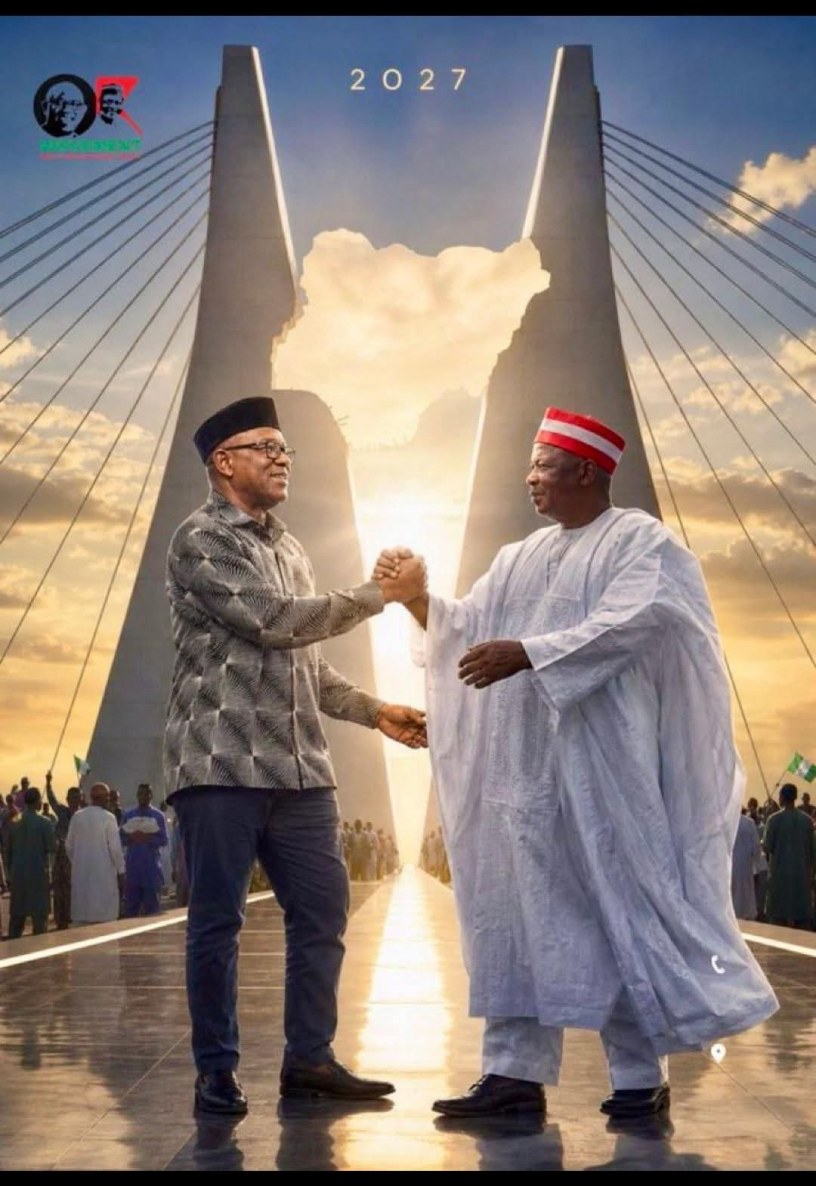
Nigerian politics is gradually entering another season of strategic realignments, and the emerging alliance between Peter Obi and Rabiu Musa Kwankwaso under the Nigeria Democratic Congress (NDC) may prove to be one of the defining developments ahead of the 2027 presidential election.
If sustained, the so-called “OK Movement” has the potential to fundamentally alter the opposition landscape and force the ruling APC into its most serious electoral contest since coming to power in 2015.
Yet the road to 2027 will not be shaped by the NDC alone. The expected emergence of former Vice President Atiku Abubakar under the African Democratic Congress (ADC) introduces a third major force into an already complicated political equation. What Nigeria may eventually witness is not a traditional two-horse race, but a triangular political contest involving the APC under President Bola Ahmed Tinubu, the NDC powered by the Obi–Kwankwaso alliance, and the ADC rallying around Atiku’s enduring Northern political network.
This changes everything.
The central lesson of the 2023 presidential election was simple: opposition fragmentation benefits incumbency. President Tinubu won not necessarily because the opposition lacked popularity, but because anti-APC votes were divided among Peter Obi, Atiku Abubakar, and Rabiu Kwankwaso.
That fragmentation may once again become the decisive factor in 2027.
The Obi–Kwankwaso alliance appears designed to correct one part of that equation. Obi brings urban voter enthusiasm, youth mobilisation, reformist appeal, and substantial influence across the South-East, South-South, and sections of the Middle Belt. Kwankwaso contributes one of the North’s most disciplined grassroots political structures through the Kwankwasiyya Movement, especially in Kano and parts of the North-West.
Individually, both men disrupted Nigeria’s traditional political order in 2023. Combined under the NDC, they could create a more nationally competitive coalition than either previously commanded.
Historically, Nigeria’s opposition only succeeds when diverse regional voting blocs unite behind a common platform. The APC itself emerged from such a calculation in 2013 when regional opposition parties and political tendencies merged to defeat the PDP. That coalition succeeded because it combined Northern electoral strength with South-West political machinery while capitalising on public frustration against the incumbent government.
The OK Movement appears to be attempting a similar political architecture.
However, the major complication for the opposition is Atiku Abubakar and the ADC.
Unlike Obi and Kwankwaso, Atiku represents an older but still formidable political establishment network with longstanding influence across Northern Nigeria and sections of the South. Despite repeated presidential defeats, Atiku remains one of the country’s most recognisable political figures with deep elite connections, financial capacity, and extensive experience in coalition-building.
If Atiku eventually emerges as the ADC presidential candidate, the opposition vote may once again become fragmented — particularly in Northern Nigeria.
This is where the APC and President Tinubu become strategic beneficiaries.
Despite economic difficulties, inflationary pressure, insecurity concerns, and growing public dissatisfaction, the APC still possesses the strongest national political structure in the country. Incumbency in Nigeria remains a powerful electoral advantage. Control of state machinery, influence across multiple governors’ forums, access to institutional networks, and deep grassroots party structures continue to give the APC enormous strategic leverage.
President Tinubu himself is also not a politically passive incumbent.
For decades, Tinubu has built a reputation as one of Nigeria’s most sophisticated coalition managers and electoral strategists. Even critics acknowledge his ability to negotiate alliances, absorb rival blocs, and maintain long-term political networks. The APC’s greatest strength may therefore lie not merely in governance performance but in political organisation.
That reality becomes even more significant if the opposition enters the election divided into multiple camps.
Should the NDC consolidate Obi and Kwankwaso’s support base while the ADC simultaneously mobilises around Atiku, the anti-incumbent vote could split in a manner remarkably similar to 2023. In such a scenario, Tinubu’s path to re-election becomes substantially easier, especially if the APC retains dominance in key battleground states across the South-West, North-West, and parts of the North-Central.
However, the situation is not entirely comfortable for the ruling party either.
Nigeria’s economic realities are reshaping voter psychology. Rising living costs, subsidy-related hardship, unemployment, currency instability, and persistent insecurity have weakened public confidence in governance. Across urban centres especially, there is growing appetite for alternative political narratives.
This dissatisfaction provides fertile ground for both the NDC and ADC.
The NDC’s strength lies in its ability to project freshness, reformist energy, and cross-generational appeal. Obi’s “Obidient” movement remains one of the most emotionally driven political mobilisations Nigeria has seen in recent times, while Kwankwaso’s movement offers disciplined grassroots operational capacity.
The ADC, meanwhile, may position itself as the experienced alternative capable of attracting establishment politicians uncomfortable within both APC and the emerging NDC coalition.
Consequently, the 2027 election may ultimately become less about ideology and more about coalition arithmetic.
The APC’s strategy will likely focus on retaining enough electoral spread and exploiting opposition fragmentation. The NDC’s mission will be to convert public frustration into a nationwide reform coalition. The ADC’s challenge will be convincing Nigerians that Atiku still represents a viable national alternative despite multiple previous attempts at the presidency.
What makes the coming contest particularly interesting is that all three camps possess identifiable strengths:
The APC has incumbency, institutional reach, governors, and political structure.
The NDC has momentum, youth enthusiasm, and anti-establishment energy.
The ADC may possess elite networks, negotiation capacity, and Northern political experience.
In the end, Nigerian elections are rarely won purely on popularity. They are won through strategic alliances, state-by-state calculations, grassroots organisation, institutional resilience, and voter turnout management.
The OK Movement has undoubtedly altered the national conversation by attempting to consolidate two major opposition tendencies under one platform. But the expected ADC candidacy of Atiku Abubakar means the opposition battlefield may remain fragmented enough to preserve APC’s strategic advantage.
For now, the biggest beneficiary of a divided opposition remains President Tinubu and the APC.
But politics in Nigeria evolves rapidly. Alliances shift, interests collide, and momentum changes unexpectedly. Between now and 2027, the decisive question may not simply be who has the loudest support base, but who best understands the mathematics of coalition politics in a deeply divided yet highly competitive democracy.
Abdul Kezo IkonAllah
Public Relations Professional, Public Affairs Analyst, and New Media Specialist
Discover more from IkonAllah's chronicles
Subscribe to get the latest posts sent to your email.
