
The world stands at the threshold of another historic transformation. Just as the internet revolution fundamentally altered how people communicate, transact business, and access information, artificial intelligence (AI) is now redefining how human beings work, create value, and live.
From banking halls to media houses, from customer service desks to classrooms, AI is rapidly changing the nature of labour across the globe. Tasks that once required human hands and minds are increasingly being handled by intelligent systems capable of learning, reasoning, and automating routine processes. The implications for Nigeria are profound.
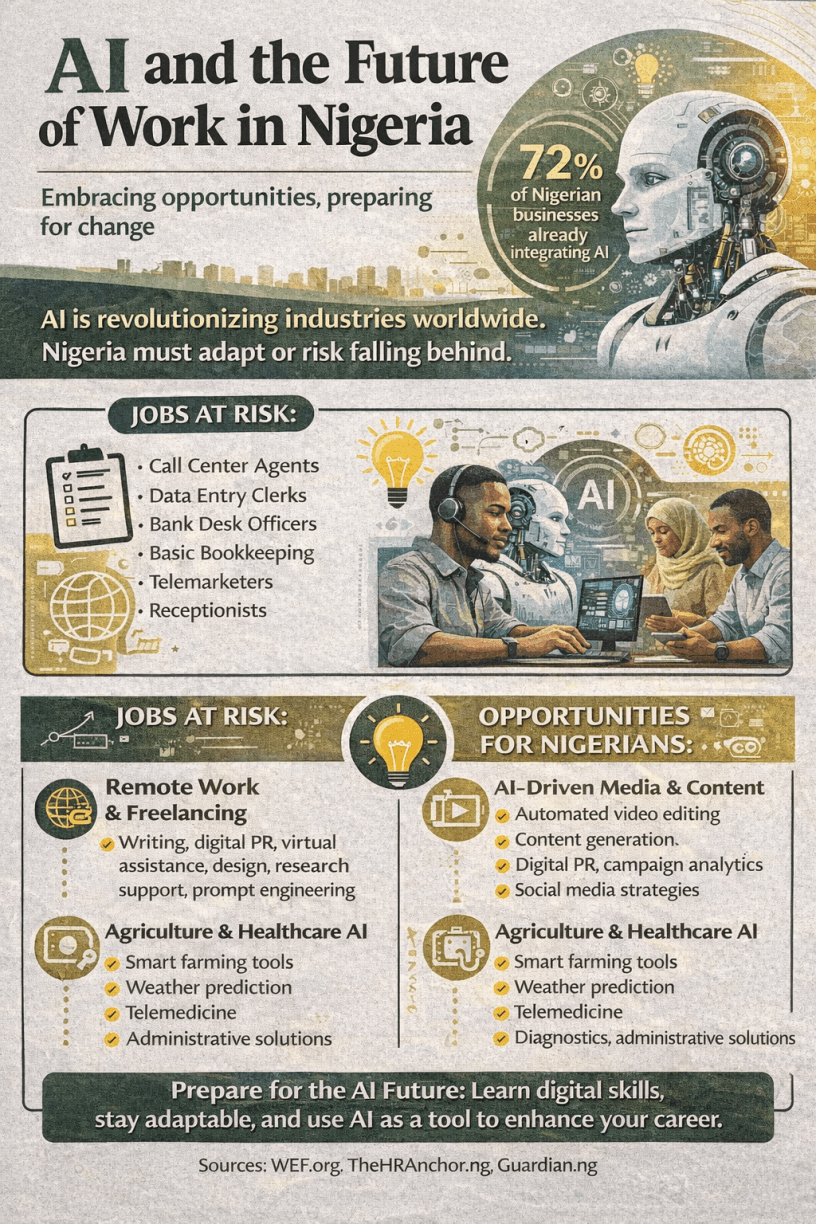
Already, sectors such as telecommunications, banking, administration, and media are witnessing the rise of AI-powered tools capable of replacing or significantly reducing traditional roles. Call centre operatives, data entry clerks, payroll officers, receptionists, telemarketers, and even junior content writers are among the categories of workers most vulnerable to automation.
Yet, this moment should not be viewed solely through the lens of fear.
History teaches us that every major technological revolution displaces some forms of labour while simultaneously creating entirely new industries and opportunities. The internet did not simply eliminate old systems; it gave birth to digital marketing, software development, e-commerce, social media management, online journalism, and the global freelance economy.
AI will do the same — but on an even larger scale.
For Nigeria, this presents both a challenge and an extraordinary opportunity. As Africa’s most populous nation with a young, energetic, and increasingly tech-savvy population, the country is well positioned to harness the AI revolution for economic growth and social advancement.
The greatest risk lies not in AI itself, but in our preparedness.
If citizens, institutions, and policymakers fail to invest in digital skills, AI literacy, and innovation ecosystems, the technology may deepen unemployment and widen inequality. However, if properly embraced, AI can unlock unprecedented possibilities for entrepreneurship, remote work, education, healthcare, agriculture, and governance.
Young Nigerians can leverage AI tools to offer services in writing, editing, graphic design, research, public relations, software development, and digital consultancy to clients across the world. Small businesses can use AI for customer engagement, inventory management, bookkeeping, and market intelligence. Farmers can benefit from predictive tools for weather forecasting and crop disease detection, while students in underserved communities can gain access to intelligent learning platforms.
The future of work is no longer a distant conversation; it is already here.
What Nigeria needs now is a deliberate national strategy that prioritises digital education, workforce reskilling, and innovation-driven policies. Universities, polytechnics, and professional training centres must integrate AI competence into their curricula. Government agencies and the private sector must work together to ensure that citizens are equipped not merely to survive this shift, but to lead within it.
Those who master AI as a tool will not be replaced by it. Rather, they will replace those who refuse to adapt.
The nations that thrive in the coming decades will be those that see AI not as a threat, but as an instrument of productivity, creativity, and national transformation.
Nigeria must be among them.
Abdul Kezo IkonAllah
Public Relations Professional, Public Affairs Analyst, and New Media Specialist
Discover more from IkonAllah's chronicles
Subscribe to get the latest posts sent to your email.
