
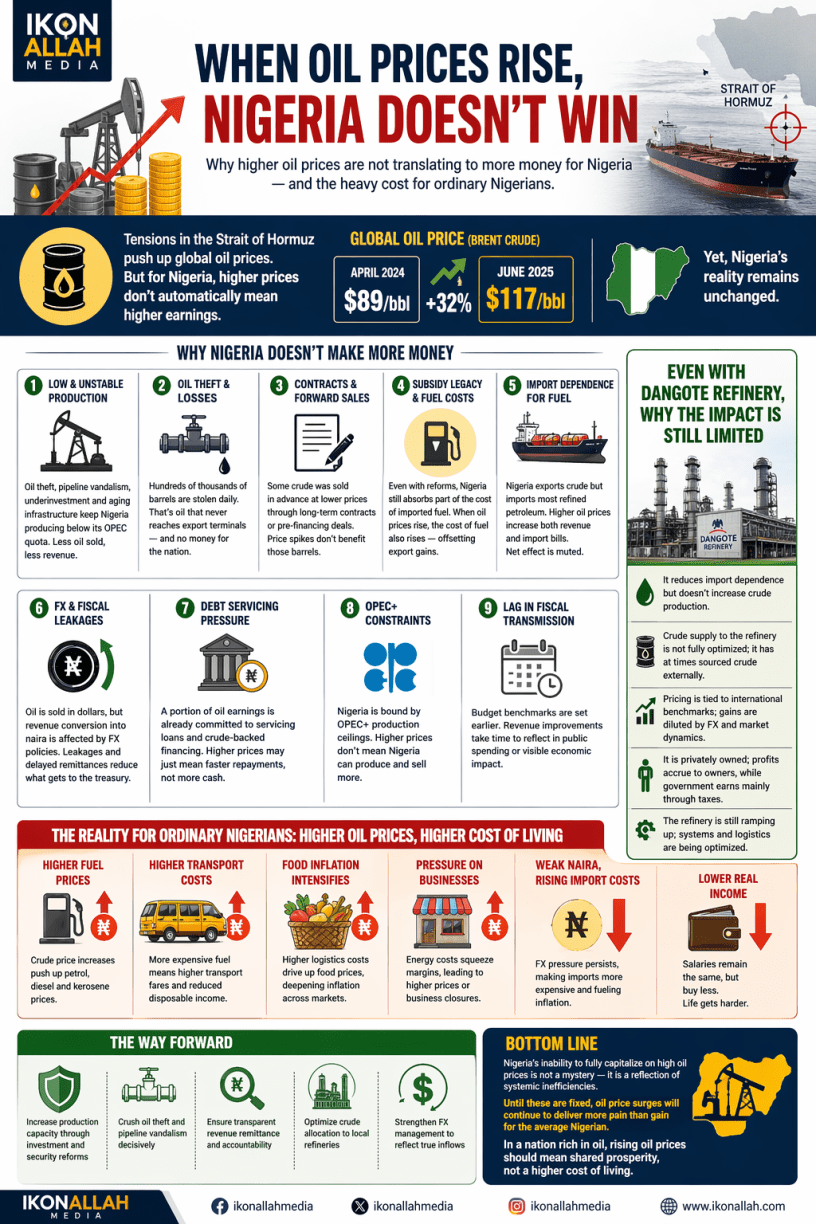
Global oil markets have once again been jolted by tensions around the Strait of Hormuz—a narrow corridor through which a significant share of the world’s crude passes. Predictably, prices of Brent crude have surged. For an oil-producing country like Nigeria, the expectation is straightforward: higher prices should translate into higher national revenue and improved economic conditions.
But reality tells a different story.
Despite rising global oil prices, Nigeria has struggled to convert this windfall into tangible economic gains. The reasons are structural, persistent, and deeply intertwined with how the country manages both its oil sector and broader economy.
The Production Problem
At the heart of the issue lies a simple equation: revenue equals price multiplied by volume. While prices are rising, Nigeria’s production has remained inconsistent. Oil theft, pipeline vandalism, and underinvestment have significantly reduced output. Even within quotas set by OPEC, Nigeria often underproduces.
In practical terms, the country is selling fewer barrels at a higher price—blunting the expected revenue surge.
Leakages and Limited Transparency
A significant portion of Nigeria’s crude oil earnings does not fully reach public coffers. Operational inefficiencies and opaque remittance structures involving the Nigerian National Petroleum Company Limited mean that what is earned is not always what is accounted for. Additionally, crude-backed loans and forward sales agreements further constrain immediate revenue gains.
The Refining Paradox
The emergence of the Dangote Refinery has been widely hailed as a transformative development. With the capacity to refine hundreds of thousands of barrels per day, it promises to reduce Nigeria’s long-standing dependence on imported petroleum products.
However, its current impact remains limited by a key constraint: crude supply. Nigeria has struggled to consistently provide sufficient feedstock to the refinery, forcing it at times to source crude externally. This undermines the potential for full domestic value capture.
Moreover, as a privately owned enterprise, the refinery’s profits accrue primarily to its owners, with government benefiting indirectly through taxes and economic activity rather than direct revenue inflows.
Why Higher Oil Prices Can Hurt Nigerians
For ordinary Nigerians, the implications of rising global oil prices are immediate and often painful.
1) Rising Fuel Prices
Even with local refining, fuel pricing in Nigeria is largely influenced by global benchmarks. As crude prices rise, so do the costs of petrol, diesel, and kerosene—either directly or through market adjustments.
2) Transportation Costs Surge
Higher fuel prices translate quickly into increased transport fares. For millions who rely on daily commuting, this erodes disposable income.
3) Food Inflation Intensifies
Transport is a major component of food distribution. As logistics costs rise, food prices follow—deepening inflationary pressures across markets.
4) Pressure on Small Businesses
From generators to logistics, energy costs are central to business operations. Rising fuel costs squeeze margins, leading to higher prices or business closures.
5) Weak Naira Dynamics
Although higher oil prices should strengthen foreign exchange inflows, Nigeria’s structural inefficiencies limit this benefit. The naira remains under pressure, making imports more expensive and fueling inflation.
The Subsidy Shadow
While Nigeria has taken steps to remove fuel subsidies, remnants of the system persist in different forms. When global oil prices rise, the government often faces political and economic pressure to cushion the impact, either directly or indirectly. This creates fiscal strain, offsetting potential gains from crude exports.
A Transition Still in Progress
Nigeria stands at a critical juncture. The combination of global oil market volatility and domestic reforms presents both risk and opportunity. The Dangote Refinery could significantly reduce import dependence, improve energy security, and stabilize supply chains—but only if supported by consistent crude production and coherent policy alignment.
The Way Forward
To fully benefit from rising oil prices, Nigeria must address foundational challenges:
Increase production capacity through investment and security reforms
Curb oil theft and pipeline vandalism decisively
Ensure transparent revenue remittance from national oil operations
Optimize crude allocation to domestic refineries
Strengthen FX management to reflect true inflows
Conclusion
Nigeria’s inability to fully capitalize on high oil prices is not a mystery—it is a reflection of systemic inefficiencies. Until these are resolved, global price surges triggered by crises near the Strait of Hormuz will continue to deliver more pain than gain for the average Nigerian.
For citizens, the paradox is stark: in a nation rich in oil, rising oil prices often mean a higher cost of living rather than shared prosperity. The challenge for policymakers is clear—bridge the gap between resource wealth and real economic benefit.
Abdul Kezo IkonAllah
Public Relations Professional, Public Affairs Analyst, and New Media Specialist
Discover more from IkonAllah's chronicles
Subscribe to get the latest posts sent to your email.
