
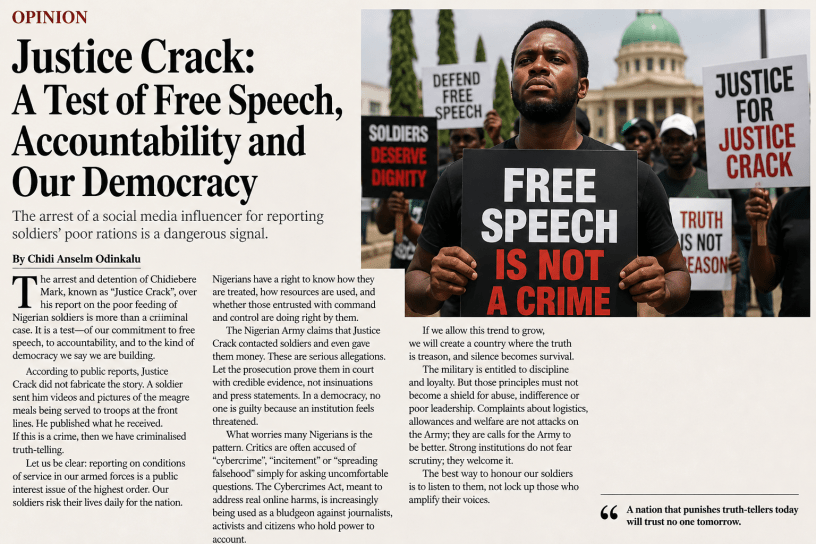
The controversy surrounding the arrest and prosecution of social media influencer Chidiebere Justice Mark, popularly known as “Justice Crack,” has evolved beyond the fate of one individual. It has become a national conversation about the delicate intersection between national security, military discipline, digital activism, and the public’s right to know.
At the center of the storm is an allegation that frontline soldiers complained about poor feeding conditions and inadequate welfare while actively engaged in counterinsurgency operations. According to public accounts, some of these complaints were allegedly communicated to Justice Crack, who subsequently amplified them on social media. The Nigerian Army, however, insists that the matter goes beyond reporting, alleging that he maintained contact with serving personnel and even transferred money to some soldiers.
Regardless of how the legal process eventually unfolds, the case already raises difficult questions that Nigeria can no longer avoid.
The first question is straightforward: if soldiers fighting for the survival of the nation are genuinely complaining about food and welfare, should the messenger become the main issue while the substance of the complaint fades into the background?
Nigeria has spent over a decade battling insurgency, terrorism, banditry, and other asymmetric security threats. Thousands of military personnel have paid the ultimate price in service to the country. In such circumstances, troop welfare is not a peripheral issue. It is central to operational effectiveness, morale, patriotism, and national security itself.
A hungry, poorly equipped, or psychologically exhausted soldier cannot perform optimally on the battlefield. History has repeatedly shown that the strength of an army is not determined solely by weapons or strategy, but by how well the institution cares for those expected to make extraordinary sacrifices.
Yet the second question is equally important.
Can civilians or social media actors directly engage serving soldiers in ways that potentially undermine military discipline and operational cohesion?
The military operates on hierarchy, obedience, and strict command structures. No serious state treats indiscipline within the armed forces casually, especially during active security operations. From the perspective of the Army, unauthorized external influence on troops could create vulnerabilities capable of damaging operational integrity.
This is where the Justice Crack matter becomes exceptionally sensitive.
If the prosecution proves that there was active inducement, coordinated agitation, or encouragement of dissent among troops, the state may argue that national security considerations justify intervention. However, if the evidence ultimately shows that the influencer merely exposed legitimate grievances sent to him independently by frustrated soldiers, then the case risks being interpreted as an attempt to criminalize whistleblowing and suppress uncomfortable truths.
That distinction matters profoundly.
Democracies thrive not by eliminating criticism, but by developing the institutional maturity to absorb criticism while correcting deficiencies. Nations do not become stronger when citizens are afraid to speak. They become stronger when institutions respond constructively to legitimate concerns.
The broader danger is that excessive securitization of public criticism can unintentionally deepen distrust between citizens and state institutions. In the age of digital communication, information control is no longer absolute. Soldiers, police officers, civil servants, and ordinary citizens possess smartphones capable of broadcasting their experiences instantly to the world.
Attempting to suppress every embarrassing revelation through arrests and prosecution may produce temporary silence, but it rarely resolves the underlying grievances.
Indeed, the real reputational challenge for the military may not be the existence of viral social media commentary. It may be whether Nigerians believe the welfare concerns being discussed are genuine.
The Nigerian Armed Forces remain one of the most respected institutions in the country because of the sacrifices made daily by personnel confronting insecurity across multiple theatres of operation. That respect should not be weakened by avoidable controversies surrounding welfare, transparency, or accountability.
The wiser approach would be to separate legitimate national security concerns from public-interest disclosures.
If there are operational breaches, they should be addressed professionally and lawfully. If there are welfare failures, they should also be addressed urgently and transparently.
Ultimately, this case should not become a battle between patriotism and accountability. The two are not enemies.
True patriotism does not demand silence in the face of institutional shortcomings. Rather, it requires the courage to confront problems honestly so that the nation and its institutions can improve.
As the courts proceed with the matter, Nigerians will be watching closely, not only to determine the fate of Justice Crack, but also to assess how the state balances security imperatives with democratic freedoms in a rapidly evolving digital society.
The outcome may shape future relations between the government, the military, the media, and an increasingly vocal online population.
And perhaps most importantly, it may determine whether the country learns to address uncomfortable truths before they become national crises.
Abdul Kezo IkonAllah
Public Relations Professional, Public Affairs Analyst, and New Media Specialist
Discover more from IkonAllah's chronicles
Subscribe to get the latest posts sent to your email.
