
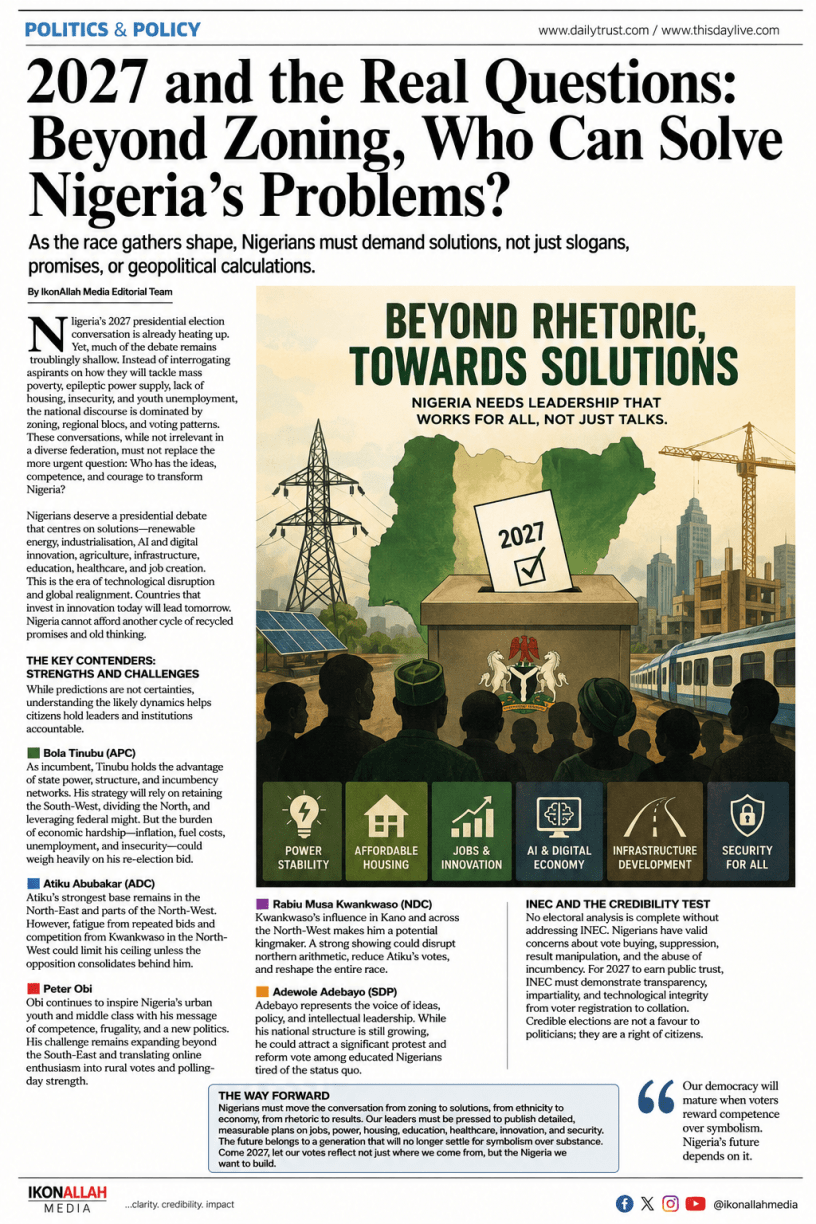
As conversations around the 2027 presidential election gradually intensify, a familiar pattern is once again dominating Nigerian political discourse. Across television studios, newspaper headlines, political meetings, and social media debates, discussions are centered less on policy and governance and more on zoning, ethnic arithmetic, religion, and regional voting calculations.
The emerging conversations are already framed around questions such as: Which geo-political zone should produce the next president? Can the North trust Peter Obi? Will the South-West remain loyal to President Bola Ahmed Tinubu? Can Atiku Abubakar consolidate the northern establishment? Will Kwankwaso divide the North-West vote? Can smaller parties disrupt the political structure?
While these questions are politically significant in Nigeria’s complicated federation, they also expose a deeper national crisis: the gradual replacement of issue-based democratic engagement with identity-driven electoral calculations.
For millions of Nigerians facing inflation, unemployment, rising insecurity, housing shortages, and collapsing purchasing power, the real concern is not necessarily where a candidate comes from but whether any aspirant possesses a credible roadmap to rescue the country from economic distress.
Unfortunately, Nigerian politics has increasingly become a contest of coalition arithmetic rather than a marketplace of ideas.
The Historical Logic Behind Zoning
To understand why zoning dominates political discussions, one must appreciate the historical fears that shaped Nigeria’s democratic evolution.
After decades of military rule, ethnic distrust, and uneven access to political power, zoning emerged as an informal stabilizing mechanism designed to reassure different regions that no part of the country would permanently monopolize presidential authority.
In principle, zoning was intended to preserve national balance and reduce feelings of marginalization. In practice, however, it has gradually evolved into a political doctrine that sometimes overshadows competence, governance capacity, and policy innovation.
Today, many Nigerians evaluate presidential aspirants primarily through the lenses of ethnicity, religion, and regional identity before assessing their plans for economic development or institutional reform.
This is particularly troubling at a time when Nigeria faces one of the most severe socio-economic crises in its democratic history.
The Economy Will Define 2027
Regardless of political alignments, the most powerful force shaping the 2027 election may ultimately be economic reality.
Across Nigeria, citizens are struggling with:
high inflation,
rising food prices,
unstable electricity,
youth unemployment,
insecurity,
a weak naira,
declining purchasing power,
and growing frustration over governance.
These challenges cut across ethnic and religious lines.
A young graduate in Kano worried about unemployment shares similar anxieties with a trader in Onitsha, a civil servant in Abuja, or a farmer in Benue. The cost-of-living crisis has nationalized economic pain in ways political elites may underestimate.
This is why many Nigerians increasingly argue that the central debate of 2027 should revolve around solutions rather than sentiments.
The critical questions should include:
How will candidates stabilize electricity supply?
What is their industrialization strategy?
How do they intend to tackle mass poverty?
What plans exist for affordable housing?
How will they reform education?
What policies will drive job creation?
How will they modernize agriculture?
What is their roadmap for digital innovation and artificial intelligence?
How will they improve electoral transparency and institutional accountability?
Sadly, such discussions remain secondary in mainstream political engagement.
AI, Innovation, and Nigeria’s Missed Opportunity
One of the least discussed aspects of Nigerian politics is the future economy.
Globally, countries are repositioning themselves around artificial intelligence, automation, renewable energy, robotics, biotechnology, digital manufacturing, and remote-work industries. Nations investing heavily in innovation ecosystems are preparing their youth populations for the next phase of global economic competition.
Nigeria possesses enormous demographic advantages. With one of the world’s youngest populations, the country could become Africa’s largest digital innovation hub if strategic investments are made in:
broadband infrastructure,
stable electricity,
digital education,
software development,
AI training,
creative technology,
semiconductor support industries,
and startup financing.
Yet political conversations rarely focus on these transformational sectors.
Instead, electoral discourse remains trapped in the language of “whose turn is it?” rather than “who has the best ideas?”
This represents a dangerous disconnect between political priorities and global economic realities.
The Likely Electoral Landscape
If the major political actors expected to shape the 2027 election eventually emerge as candidates, Nigeria may witness one of its most fragmented presidential contests in recent history.
President Bola Ahmed Tinubu and the APC would likely rely heavily on incumbency advantage, state structures, governors, and the extensive political machinery built over decades.
Former Vice President Atiku Abubakar would remain influential within parts of the northern political establishment and could retain substantial support across sections of the North-East and North-West.
Peter Obi would likely continue to dominate among urban youth, educated middle-class voters, and many southern and Middle Belt constituencies frustrated with traditional political structures.
Rabiu Musa Kwankwaso could once again become a major factor in northern electoral calculations, particularly in Kano and sections of the North-West where the Kwankwasiyya movement remains influential.
Meanwhile, figures such as Adewole Adebayo may continue attracting attention among reform-minded Nigerians seeking issue-based politics outside the dominant parties.
However, the most decisive factor may not be individual popularity but opposition unity.
Historically, incumbents in Nigeria become most vulnerable when opposition forces successfully consolidate regional and ideological blocs into a single electoral coalition. If opposition parties remain fragmented, the ruling party benefits from divided anti-incumbent votes.
Electoral Integrity and Democratic Trust
Another major issue likely to shape public sentiment ahead of 2027 is trust in the electoral system.
Concerns about election transparency, vote collation, judicial intervention, misuse of incumbency power, and institutional neutrality have become recurring features of Nigeria’s democratic process.
Public skepticism toward electoral institutions reflects a broader crisis of confidence in governance structures.
For democracy to retain legitimacy, Nigerians must believe that:
votes count,
electoral institutions remain independent,
security agencies act professionally,
and the judiciary protects democratic principles rather than political interests.
This places enormous responsibility on institutions such as INEC, civil society organizations, the media, the Nigerian Bar Association, and the judiciary to strengthen electoral transparency before the 2027 cycle intensifies.
Without public trust, elections risk becoming exercises in elite negotiation rather than expressions of popular sovereignty.
The Future of Nigerian Democracy
Nigeria is currently navigating a difficult transition between identity politics and developmental politics.
Identity politics asks: “Who represents us?”
Developmental politics asks: “Who can govern effectively?”
Both questions matter in a multi-ethnic federation. However, a country battling severe economic hardship cannot afford to ignore competence, innovation, and policy depth.
The 2027 election will therefore test not only political parties and candidates but also the maturity of Nigeria’s democratic culture.
Will voters prioritize regional sentiments over economic recovery?
Will political parties present detailed development blueprints?
Will youth voters sustain pressure for issue-based campaigns?
Will institutions guarantee transparent elections?
The answers to these questions may ultimately determine whether Nigeria moves toward a more accountable democracy or remains trapped in an endless cycle of elite political bargaining.
For a generation struggling with poverty, unemployment, insecurity, and uncertainty, the stakes could not be higher.
Abdul Kezo IkonAllah
Public Relations Professional, Public Affairs Analyst, and New Media Specialist
Discover more from IkonAllah's chronicles
Subscribe to get the latest posts sent to your email.
