
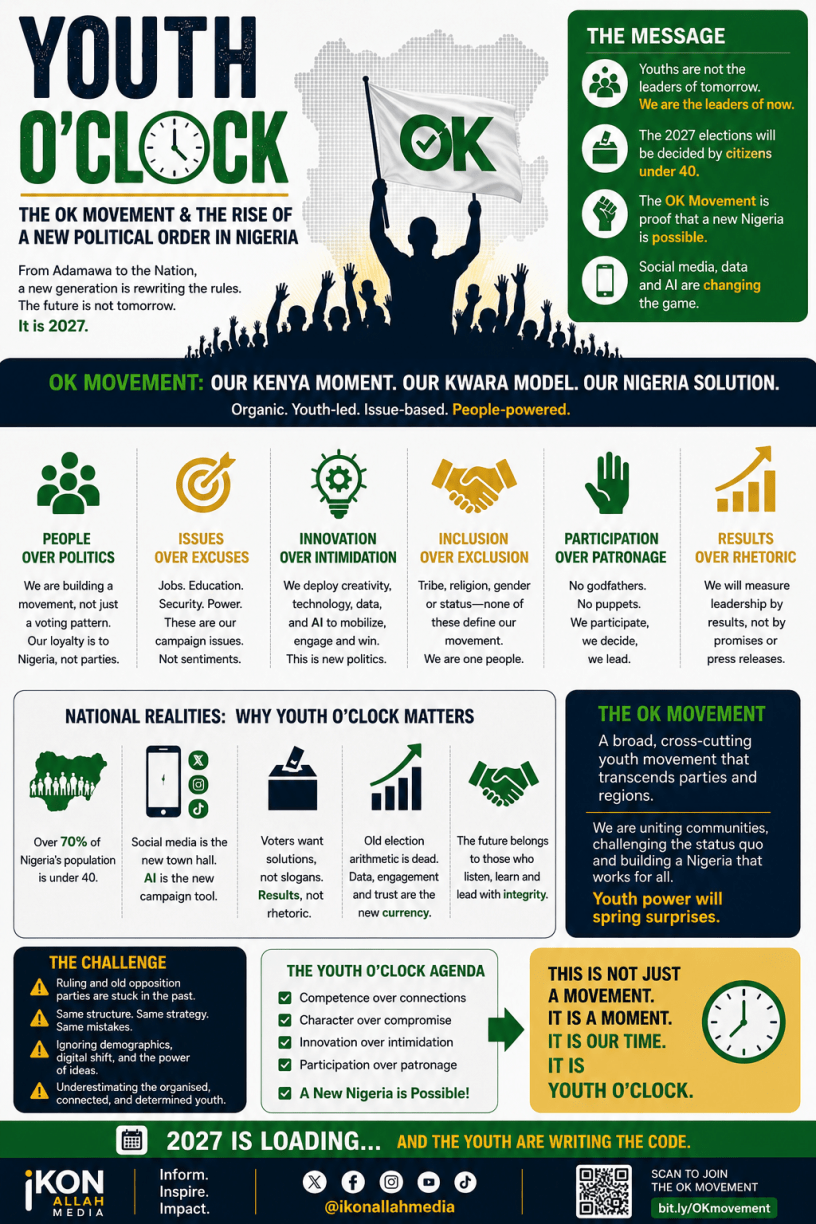
Politics in Adamawa State is increasingly reflecting a broader national reality — the rise of youth-driven political consciousness that is gradually reshaping electoral calculations across Nigeria. The emerging political momentum around younger politicians in different parties shows that the conversation about leadership is slowly shifting from age and political seniority toward relatability, innovation, digital engagement, and generational appeal.
Across party lines in Adamawa, younger political figures are beginning to dominate public conversations. In the All Progressives Congress (APC), Abdulrahman Bashir Haske has emerged as one of the most discussed names among politically active youths, while in the Labour Party, Senator Ishaku Abbo continues to command significant attention, especially among younger voters and digital political communities.
Their political styles may differ, but both represent a broader reality: Nigerian youths are increasingly searching for leaders they consider accessible, energetic, media-savvy, and connected to their aspirations.
When his name first gained prominence in Adamawa’s 2027 political calculations, many observers, including this writer, were sceptical. Nigerian politics has historically favoured older politicians with decades of patronage networks, entrenched structures, and elite political alliances. The assumption was simple: youthfulness may attract attention, but it rarely translates into viable political momentum.
However, the unfolding political reality in Adamawa — and indeed across Nigeria — suggests that many old political assumptions are becoming increasingly obsolete.
The growing popularity of younger politicians in Adamawa reflects a deeper national shift. Across Nigeria, many voters under 40 are increasingly questioning traditional political structures and seeking leaders who understand contemporary realities such as unemployment, technology, entrepreneurship, social media influence, and digital economic opportunities.
What makes this political transition significant is not merely the age of the politicians involved, but the method of engagement. Younger political actors increasingly understand the importance of strategic communication, grassroots visibility, media perception, and online mobilisation.
The growing enthusiasm around youth-oriented political movements reflects more than support for individual aspirants. It represents a broader generational hunger for political relevance among millions of young Nigerians who increasingly feel disconnected from traditional political establishments.
For decades, political calculations in Nigeria relied heavily on ethnic arithmetic, godfather networks, financial influence, and conventional mobilisation methods. While those factors still matter, the electoral environment is changing rapidly.
The 2027 elections may become the clearest evidence yet that demography is beginning to redefine Nigerian politics.
In Adamawa, as in many parts of Nigeria, voters under the age of 40 now constitute a powerful electoral bloc. They are digitally connected, politically expressive, socially aware, and less emotionally attached to old political loyalties. Their political opinions are increasingly shaped not by traditional ward meetings alone, but by social media conversations, digital campaigns, online communities, and influencer-driven narratives.
This is where many traditional politicians and political parties may be dangerously misreading the future.
Most ruling parties across Nigeria still operate with outdated electoral assumptions. Their strategies are built around old coalition models, physical rallies, elite endorsements, and legacy structures, while underestimating the disruptive impact of technology, artificial intelligence, and digital political communication.
Modern elections are no longer fought only on billboards and campaign grounds. They are increasingly being shaped on smartphones.
Social media has fundamentally altered political engagement. A candidate with digital appeal, media intelligence, and strong youth connection can generate momentum faster than politicians with traditional structures but weak public enthusiasm.
Artificial intelligence is also gradually entering the political space. From voter sentiment analysis and message targeting to rapid content production and digital engagement, AI is changing campaign strategies globally, and Nigeria will not be exempt from this transformation.
The politicians who understand this evolution early will possess a major strategic advantage.
The emerging “Youth O’Clock” movement across Nigeria is therefore not merely a slogan anymore. It is becoming an electoral force. Young people are increasingly determined to influence candidate selection, public discourse, and electoral outcomes.
This is why youth-oriented political movements across different parties may produce unexpected outcomes in 2027.
The “OK Movement” has increasingly become part of conversations around youth political mobilisation and generational change. The movement reflects how younger voters are rallying around political identities built not only on party structures, but also on visibility, accessibility, digital communication, and emotional connection with the electorate.
The growing influence of digitally connected young voters is gradually disrupting old electoral assumptions.
The mistake many established politicians continue to make is assuming that the voting behaviour of 2027 will mirror that of 2015 or even 2023. It may not.
Nigeria’s demographic realities are changing rapidly. A generation raised in the digital era now consumes politics differently. They value accessibility, relatability, communication skills, innovation, and visibility. They are more likely to engage with politicians who speak their language, understand their aspirations, and project a future-oriented vision.
This does not automatically guarantee electoral victory for younger politicians. Nigerian elections remain complex, and structures still matter. Experience, alliances, resources, and political negotiations will continue to influence outcomes.
However, one reality is becoming increasingly difficult to ignore: youth-driven political momentum is no longer peripheral. It is gradually moving toward the centre of Nigerian politics.
Adamawa may become one of the states where this transition becomes most visible, but the trend itself is national.
The state has historically produced politically influential figures with national relevance, but the coming electoral cycle may introduce a different political template — one driven less by age hierarchy and more by generational resonance.
Whether these younger political actors eventually secure electoral victories or not, their emergence has already exposed the changing dynamics of modern political engagement. They have demonstrated that younger politicians can no longer be dismissed as symbolic participants in the political process.
That alone makes the ongoing political developments in Nigeria worthy of serious national attention.
As 2027 approaches, political actors across Nigeria may need to reassess their assumptions about voter behaviour, campaign strategy, and political influence.
Because the future of Nigerian politics may belong to those who understand one critical reality early enough: the youth are no longer waiting for power to be handed to them; they are positioning themselves to shape it.
Abdul Kezo IkonAllah
Public Relations Professional, Public Affairs Analyst, and New Media Specialist
Discover more from IkonAllah's chronicles
Subscribe to get the latest posts sent to your email.
