
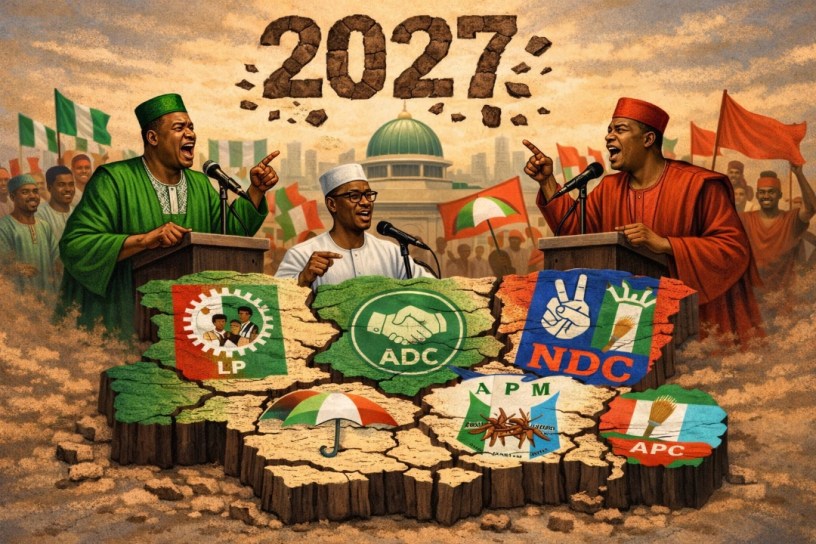
Nigeria’s political landscape is gradually drifting toward 2027, but the emerging contours of competition suggest less a consolidation of alternatives and more a multiplication of opposition fragments. While public sentiment is increasingly defined by economic pressure, insecurity concerns, and governance fatigue, sentiment alone rarely determines electoral outcomes in a system still heavily shaped by party structure, elite coordination, and regional bargaining.
Recent political realignments around emerging opposition platforms, particularly discussions of zoning arrangements and possible cross-regional tickets, reflect an attempt to respond to these pressures. However, the central question remains whether these arrangements are credible enough to survive the transition from elite negotiation to mass electoral trust.
The proposed zoning logic—South for one term, North thereafter—has intuitive appeal in a country where rotational power-sharing has become an informal stabilizer. Yet Nigerian politics has repeatedly demonstrated that zoning agreements, absent enforceable institutional guarantees, function more as political promises than binding commitments. Their success depends less on design and more on the durability of trust between competing power blocs.
This is where the northern political calculus becomes decisive. Any arrangement perceived as symbolic concession rather than genuine power redistribution is likely to face skepticism from key northern constituencies. The issue is not simply ethnicity, but elite alignment, machine politics, and the capacity to deliver tangible returns within established political networks. In such a context, competing northern figures with independent bases of influence will inevitably complicate any unified bloc strategy.
At the same time, the opposition’s structural weakness is increasingly evident. The fragmentation of major platforms, internal factional disputes, and competing presidential ambitions are creating a diffusion of electoral strength rather than consolidation. The emergence of multiple opposition candidacies—whether within established parties or newer platforms—risks repeating a familiar pattern in Nigerian elections: the division of protest votes across multiple channels, thereby strengthening incumbency by default.
The ruling party, despite public discontent in several quarters, continues to benefit from this fragmentation. Incumbency in Nigeria is not merely about popularity; it is about coordination capacity. Control over party machinery, access to subnational structures, and alignment with influential political elites remain decisive factors. When opposition forces fail to unify, these advantages become even more pronounced.
The question of whether a sentiment-driven coalition can overcome entrenched political structures is therefore central to the 2027 outlook. While opposition figures with strong urban and youth appeal have demonstrated their capacity to reshape political discourse, electoral victory requires more than momentum. It requires a nationwide coalition that bridges regional blocs, reconciles elite interests, and sustains organizational discipline over time.
Factional candidacies within emerging parties further complicate this equation. Rather than expanding the opposition’s reach, they often function as centrifugal forces, dispersing energy that might otherwise contribute to a coherent electoral challenge. In competitive elections, such dispersion rarely yields advantage; it typically consolidates the position of the most organized actor.
Ultimately, the 2027 presidential election is shaping up less as a referendum on individual personalities and more as a test of political architecture. Sentiment is rising, but structure remains decisive. Zoning narratives, coalition experiments, and factional realignments will matter only insofar as they produce a unified, disciplined, and credible electoral platform.
Without that, Nigeria may once again witness a familiar outcome: a divided opposition confronting a structurally coordinated incumbent advantage, where the arithmetic of fragmentation outweighs the momentum of public dissatisfaction.
Discover more from IkonAllah's chronicles
Subscribe to get the latest posts sent to your email.
